
Artificial Intelligence is no longer a novelty; it is the default standard of the modern business world. However, there is a major paradox: If everyone is using it, why are so few deriving meaningful profit from it?
McKinsey’s November 2025 report, “The State of AI in 2025: Agents, Innovation, and Transformation,” answers this question with brutal clarity: Many are using AI, but very few are generating value. This value gap is the operational face of The Great Rebuild: organizations must shift from “machine logic” to “living systems” built around data + agents. (Link: The Great Rebuild)
The Gap Between Expectation Inflation and Reality
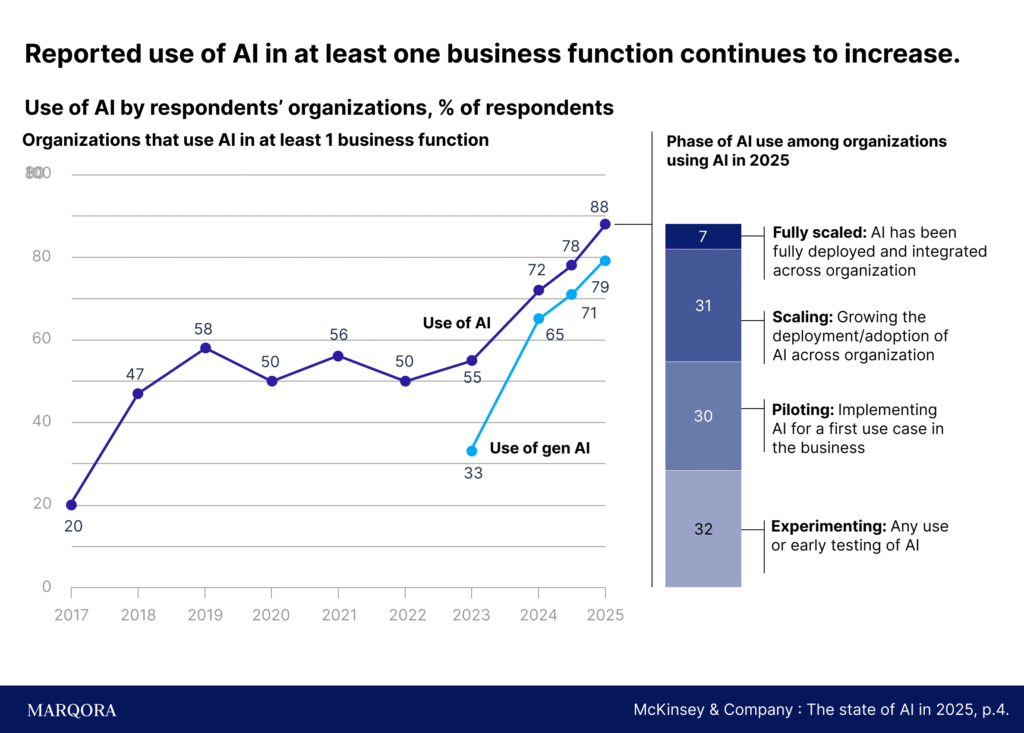
The chart below lays bare Jim Collins’ principle of “confronting the brutal facts” in its starkest form.
When diving deep into the report, 3 critical turning points emerge that will move your AI strategy from “ordinary” to “superior” in 2025.
Reading the Table: 88% of companies say they are using AI; this is massive adoption. However, the column on the right reveals the other side of the coin:
62%: Are still spinning their wheels in the “experimentation” or “pilot” phase.
31%: Are trying to scale.
Only 7%: Have achieved fully scaled integration.
This table proves one thing: Possessing the technology means nothing on its own. The real issue is how you embed that technology into the heart of the business.
1. The Role of Technology: An Accelerator or a Creator?
At the root of the failure to move from pilot projects to real transformation lies the wrong role attributed to technology.
Jim Collins clearly defines this trap in his work Good to Great: “Technology is an accelerator of momentum, not a creator of it.” McKinsey data confirms this principle.
Technology alone cannot ignite a transition from “good to great”; it can only skyrocket a strategy that is already correctly structured.
A clean example of “technology as an accelerator” (not a creator) is Vertical AI in wealth management—FINNY AI turns process redesign into measurable organic growth. (Link: FINNY AI)
The most distinct characteristic of high-performing companies is that they radically redesign their processes. For them, the rule is simple: AI is not an accelerator added to existing chaos; it is a tool to rethink the business.
Process Design: Successful companies are 3 times more inclined than others to design their workflows from scratch based on AI.
Leadership: AI success is not an IT project, it is a CEO agenda. In successful companies, the rate of ownership by top management is also 3 times higher.

2. The Drucker Test: Don’t Fall into the Efficiency Trap
Peter Drucker’s famous distinction is more vital today than ever: “Efficiency is doing things right; effectiveness is doing the right things.”
Efficiency—focusing on doing things right—is a minimum condition for success, but it does not ensure success on its own. Succeeding in AI integration means not just being efficient (using it), but implementing the right AI strategy aligned with the business purpose.
According to the report, 80% of companies use AI solely for efficiency (cutting costs, providing automation). In Drucker’s terms, they focus only on “doing old jobs faster.” Indeed, the report confirms this with a painful statistic: While 64% of participants say AI increases innovation, the rate of those seeing a positive impact on company-wide profitability (EBITDA/EBIT) remains at only 39%.
However, McKinsey’s “High Performers” group plays the game differently:
Their focus is not savings, but growth and innovation.
They use AI not to speed up old processes, but to create new business models.

Savings keep you alive, but innovation moves you forward. If your strategy is only to cut costs, falling behind the competition is inevitable.
Sectoral and Functional Depth: What Do the Numbers Say?
When we look closer at the McKinsey data, we see that AI is not distributed equally “everywhere,” and certain sectors and functions have broken away from the rest:
The Surprise Leader: Insurance Sector. Often considered traditional, the Insurance sector is competing with the Technology sector in AI adaptation. They have the highest usage rates across all sectors, particularly in Knowledge Management (64%) and Service Operations (60%). This is the clearest proof that data-intensive sectors are leading the transformation.
The Entry Gate for Organizations: “Knowledge” and “Marketing.” Independent of the sector, the two areas where companies touch AI the most are Knowledge Management and Marketing/Sales. Companies prioritize using AI first to organize corporate memory and reach the customer; meaning, areas that process “words and data” are prioritized.
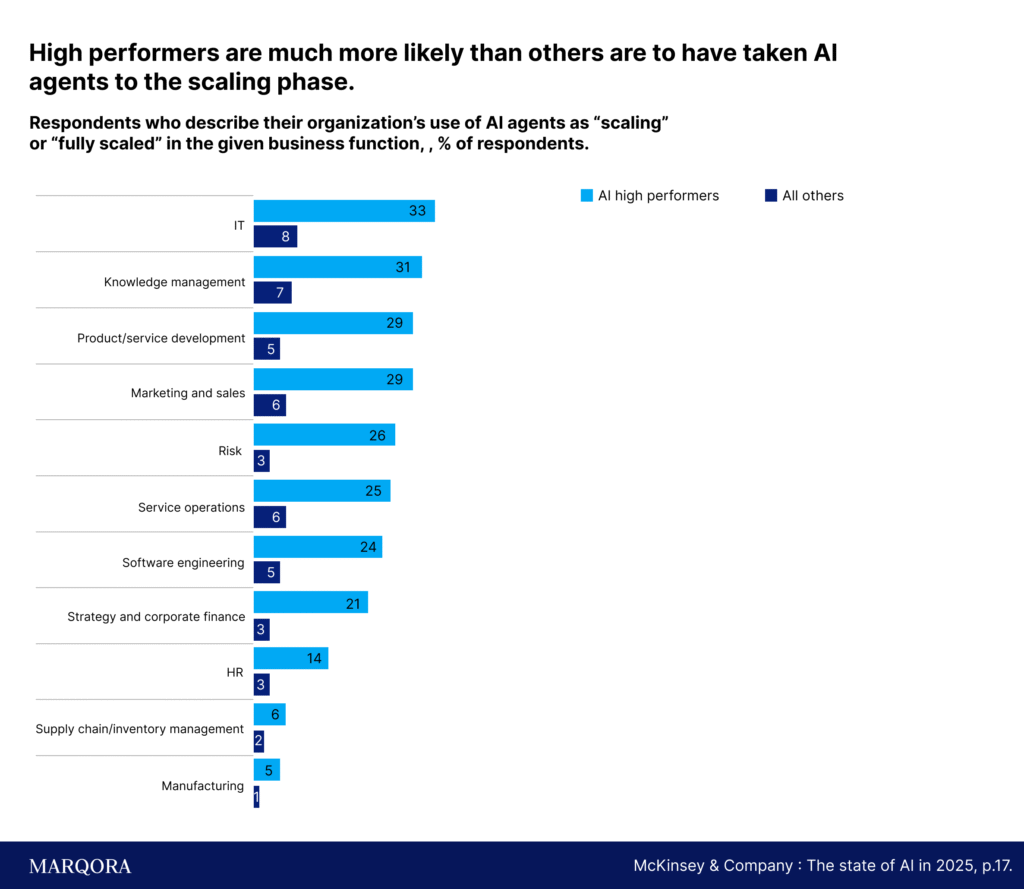
Resistance of the Physical World: Manufacturing and Supply Chain. While adaptation rises rapidly in digital processes (IT, Software, Finance), processes touching the physical world are lagging. Manufacturing and Supply Chain functions are well below the general average. This shows that moving AI from “bits” to “atoms” (physical operations) remains the biggest challenge.
Technology’s Dominance on Home Turf: As expected, Technology companies outpace all other sectors in Software Engineering (58%) and IT (56%). Those who use AI most intensively in their own kitchen naturally become the ones who scale this technology best.
3. The New Reality: Agents and the “What If It Goes Wrong?” Risk
The biggest trend of 2025 is the shift from bots awaiting commands to “AI Agents” capable of autonomous planning. 62% of companies are testing these agents. However, only 10% are able to scale them operationally.
For the organizational model behind agents (machine → organism, “octopus” logic), see: The Great Rebuild: The Era of the Machine is Over.
What is critical here is not to dehumanize technology, but to position the human correctly. The most successful companies in the report operate on the “Human-in-the-loop” principle.
For the primary risk is no longer ‘AI cannot do this,’ but rather the question, ‘What happens if it gets it wrong?‘ The report emphasizes that the number one risk organizations are managing is ‘inaccuracy’. Recognizing this inevitable margin of error, high performers do not push humans out of the loop; instead, they position them at the very center of the process as ‘validators’ to oversee model outputs.

Conclusion: The 2026 Roadmap
The McKinsey AI report delivers a clear message: In the age of AI, it is mindset, not technology, that makes the difference. If you want to emerge from the graveyard of pilot projects and create real value in 2026:
Change Course: Focus on innovation, not just efficiency.
Rebuild: Don’t patch AI onto existing processes; redesign your processes according to AI.
Lead: Don’t hand this transformation over to the IT department; own it from the very top.
Don’t Forget the Human: Use AI Agents, but do not remove the human from the oversight mechanism.
The technology is ready. So, is your organization ready for this mindset shift?
Continue the chain
Start with the macro frame: The Great Rebuild (Machine → Organism)
Then see a real Vertical AI case: FINNY AI (Growth Engine in Wealth Management)