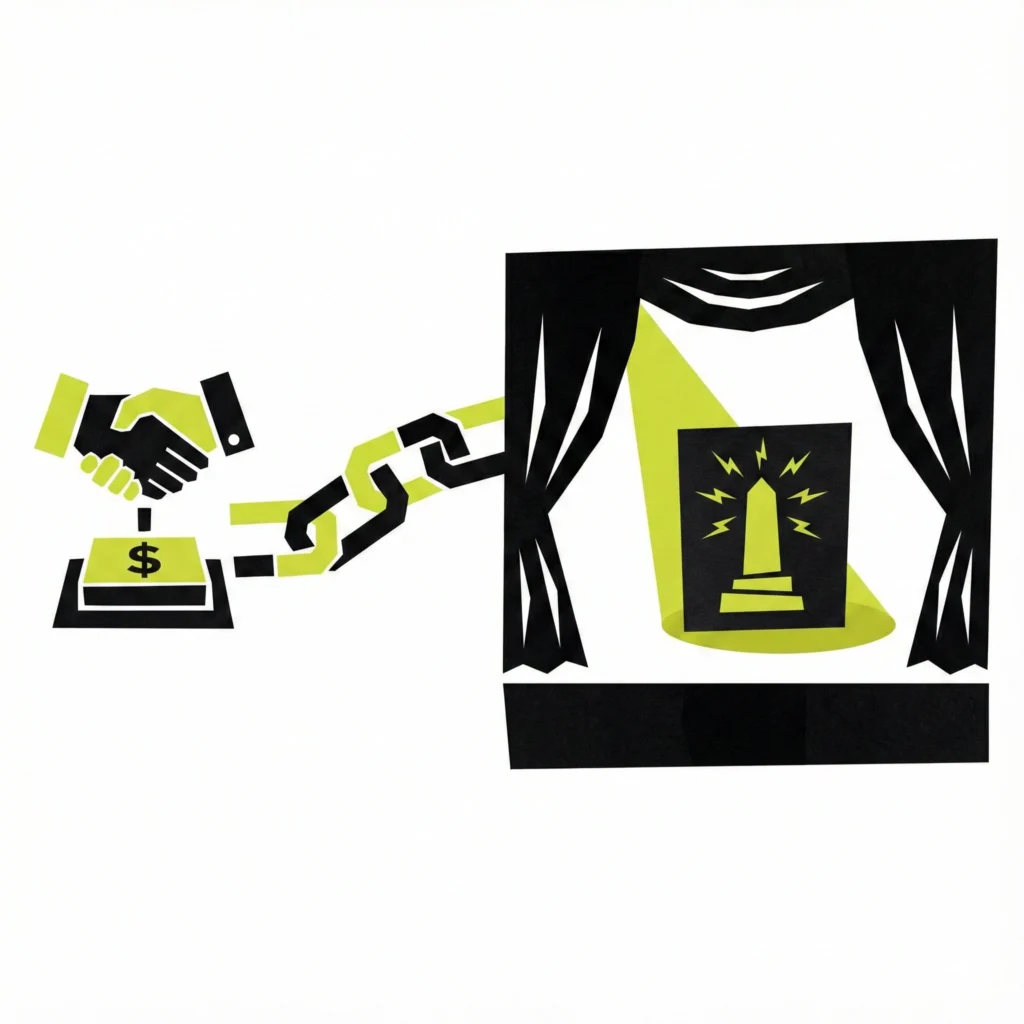
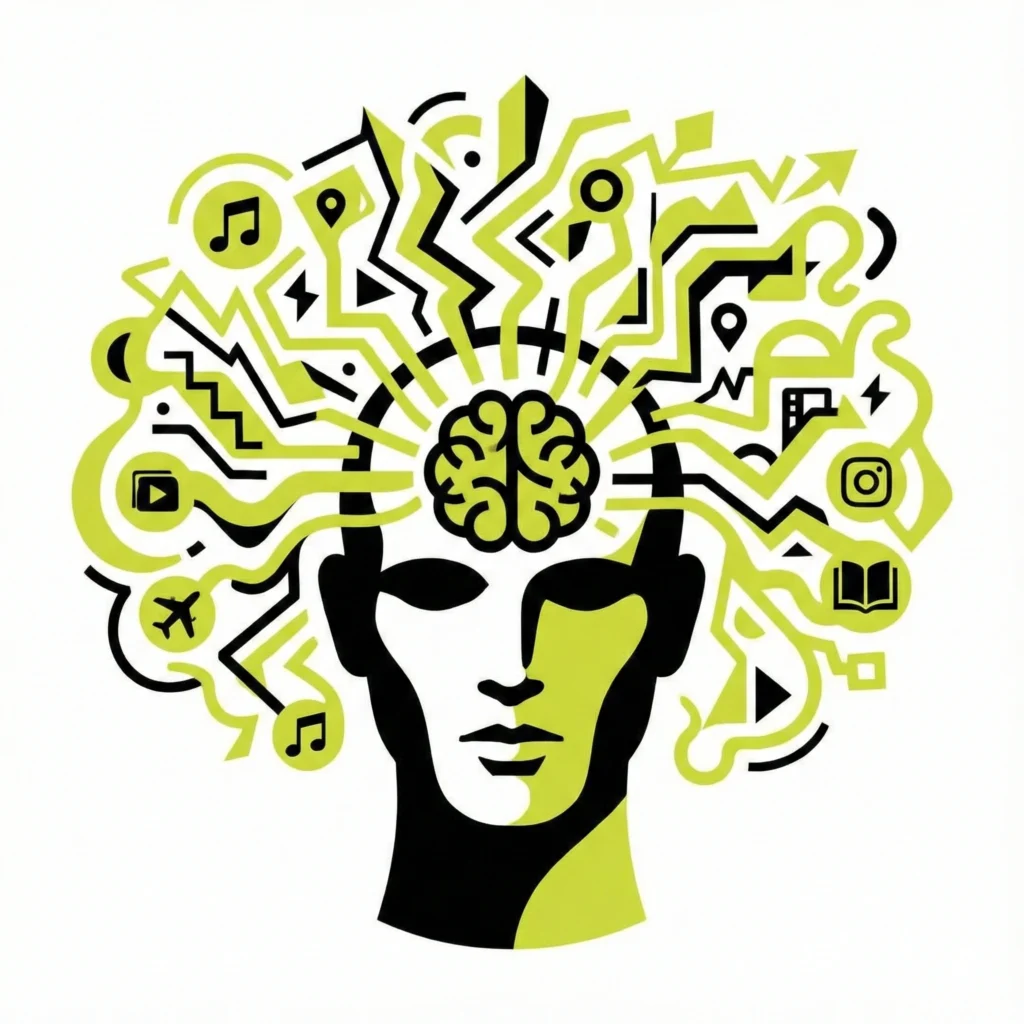
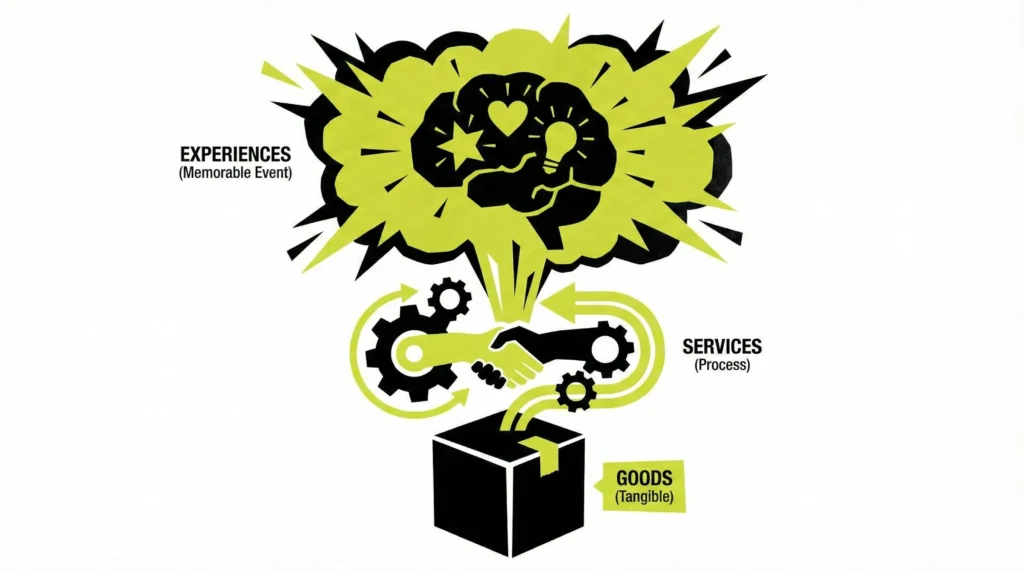
For years, when marketing was discussed, people first thought of products, then services; experience often came third, sometimes even as a footnote. Yet Pine and Gilmore said long ago that the game actually works in reverse: products and services set the stage; the true thing being sold is the “memory” that stays in the customer’s mind.
1.1. From the physical stage to the mental stage
Think of a good restaurant: it is remembered not only for its dishes, but also for its lighting, music, the attitude of the waiter, the photos on the wall, and the small details on the table. The money you pay at Starbucks is not just for the coffee; you also pay for the experience that turns the time spent there into a “small ritual.” Brands like Planet Hollywood and Hard Rock Café don’t just serve food; they sell the feeling of a “movie set.” Las Vegas hotels take this to the extreme with themes like Rome, Paris, or New York, while Walt Disney builds fully designed worlds ranging from cowboy towns to fairy-tale castles.
The task of the experiential marketer is to restore a soul to objects and processes that have become ordinary.
In recent years, physical stores have stopped being places where shelves are stocked and products sold; instead, they have transformed into stages. For example, in Nike’s House of Innovation stores in New York and Shanghai, you walk among massive digital screens, athlete profiles, and interactive test zones, making you feel less like a shopper and more like a participant in a sports narrative. REI’s experience for outdoor enthusiasts goes even further: in some stores you can climb a rock wall or test outdoor jackets under a real artificial downpour — meaning you make the purchase decision by actually using the product.
We see the same approach in Dick’s Sporting Goods’ rapidly expanding House of Sport concept; golf putting areas, turf fields for field sports, climbing walls, and racquet stringing services transform shopping into a kind of sports-club activity. In fashion and technology, Farfetch’s “Store of the Future” project opened a new chapter. Interactive mirrors, personalized product suggestions, and online behavior data connect the in-store experience into a single flow, turning shopping into a fully personalized fashion journey.
These examples have a common point: whether you are a sports enthusiast, an outdoor lover, a follower of luxury fashion, or an ordinary consumer—people now go to a store not just to buy a product, but to live a moment. Because experiential retail does not only display the product; it transforms the brand’s identity, energy, rhythm, and imagination into a memorable stage in the customer’s mind. All do the same thing: they link the purchase decision to a scene that becomes imprinted in memory.
All sellers provide a service; the hard part is accompanying an experience the customer will remember years later.
2. The New Actor in This Story: Artificial Intelligence (AI)
Until recently, such experiences depended almost entirely on physical touchpoints. Today, however, artificial intelligence is silently but fundamentally redefining the experience economy. The issue is no longer one-off events prepared for weeks by a human team; it is dynamic, fluid, hyper-personalized experiences generated by AI in seconds.
Studies published over the past year show that generative AI (GenAI) significantly increases engagement and emotional response through personalized content in marketing. For example:
A comprehensive 2024 study on the role of generative AI in marketing and advertising shows that GenAI strengthens consumer engagement and “human-like” content through hyper-personalized campaigns.
In short: AI is no longer the “supporting actor” in experience design — it is becoming the architect that builds the stage.
3. Hyper-Personalization: The New Raw Material of Experience
In the past, an experience designer wrote an “average” scenario for a broad audience. Today, AI functions like a personal narrative engine that reads not only past behavior but also the user’s context, mood, and intent at that moment.
Case and investment examples
Personalization and basket value
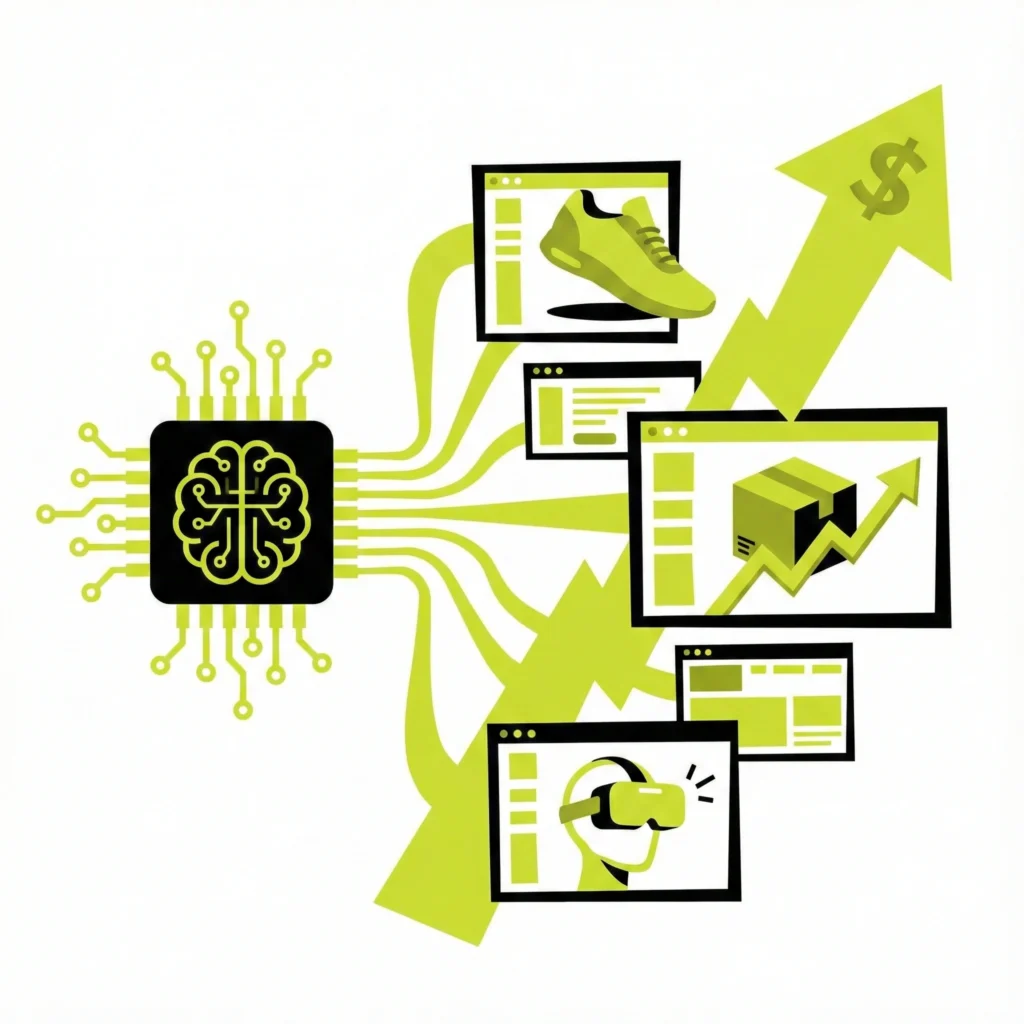
New e-commerce case studies report that AI-driven personalization increases average order value by 10–30%; in some applications, a 23% increase has been documented.
ShopOS – AI-based e-commerce operating system
Funded with $20 million in 2025 by Flipkart co-founder Binny Bansal, ShopOS develops an AI-powered e-commerce operating system for brands. Processes like product listing, campaign design, and store personalization are automated according to user behavior; each visitor sees a different digital storefront.
Insider is one of the fastest-growing global SaaS platforms enabling brands to orchestrate personalized experiences across web, mobile, email, and messaging channels. Using predictive algorithms and real-time behavioral analysis, Insider builds a unique experience journey for each visitor. Its AI recommendation engine and dynamic segmentation tools are used by over 1,200 enterprises worldwide. In 2024, Insider raised a $500M Series E led by General Atlantic, bringing its total funding to over $770M and strengthening its position as one of the most valuable martech companies emerging from the region.
BrandXR – AI-powered experiential advertising and personalization
BrandXRcreates AI-driven personalized experience pages and 3D/AR campaigns for brands. Referring to Boston Consulting Group’s findings that AI-driven personalization can increase sales by around 20%, it highlights the link between personalization and revenue.
Skeepers – AI-powered UGC and experiential commerce
Skeepers analyzes user-generated content with AI to identify emotional signals, preference patterns, and influencer impact. The platform helps brands design immersive and emotionally resonant content journeys, reinforcing the link between personalization, authenticity, and consumer engagement.
Zoovu – AI product discovery and conversational experience engine
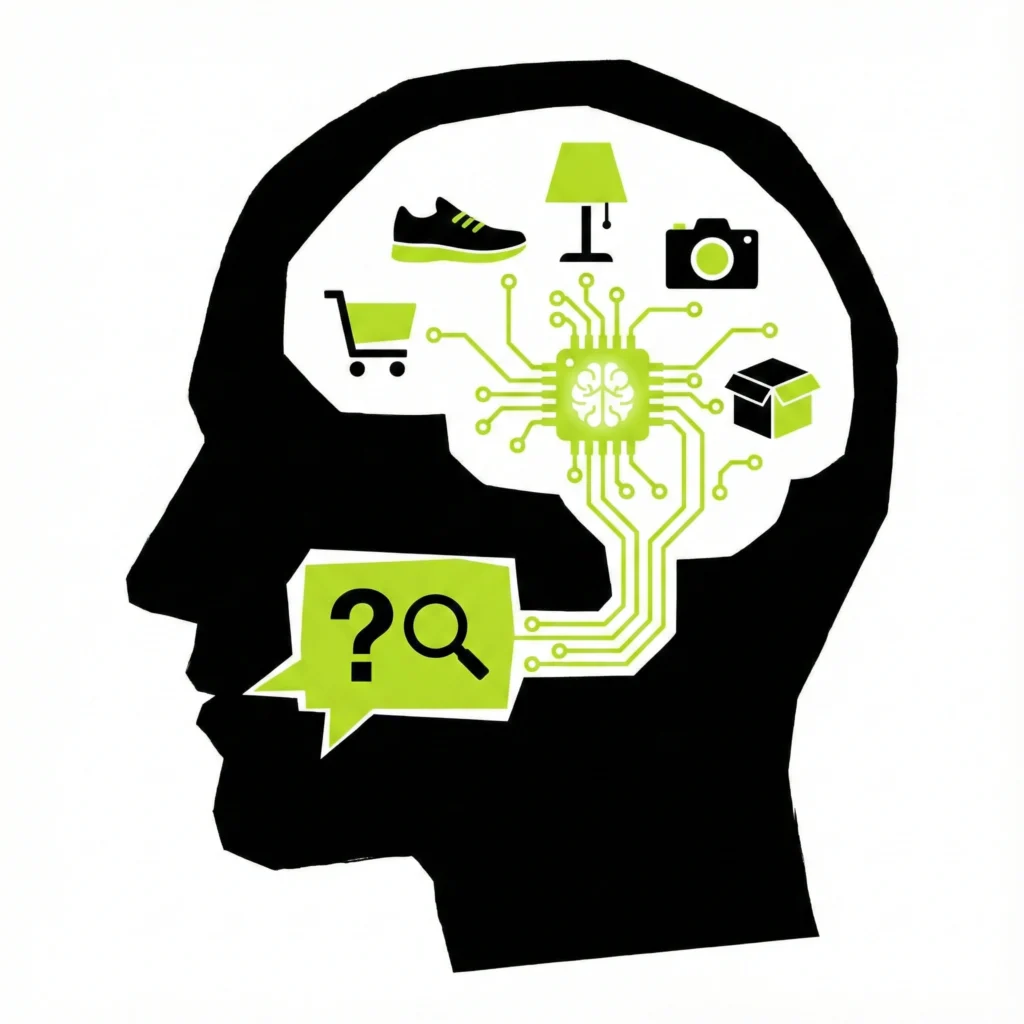
Zoovu powers conversational product finders used by global brands across retail, electronics, and automotive. By understanding user intent through natural-language inputs and preference modeling, Zoovu creates tailor-made discovery experiences that replace generic category browsing with personalized guidance. In 2022 Zoovu raised a $169M Series C led by FTV Capital to accelerate its global expansion and AI-powered discovery platform development.
These examples confirm the “personal storefront” thesis in practice: Immersion is no longer achieved only in physical space, but also through scenes generated on the user’s screen in milliseconds.
4. AI Experience Interfaces: The New Face of the Brand
Today, the real breakthrough in experience design comes from AI Experience Interfaces that go beyond traditional chatbots.
These are no longer bots that merely answer questions; they are digital characters that carry the brand’s tone of voice, values, and “personality.”
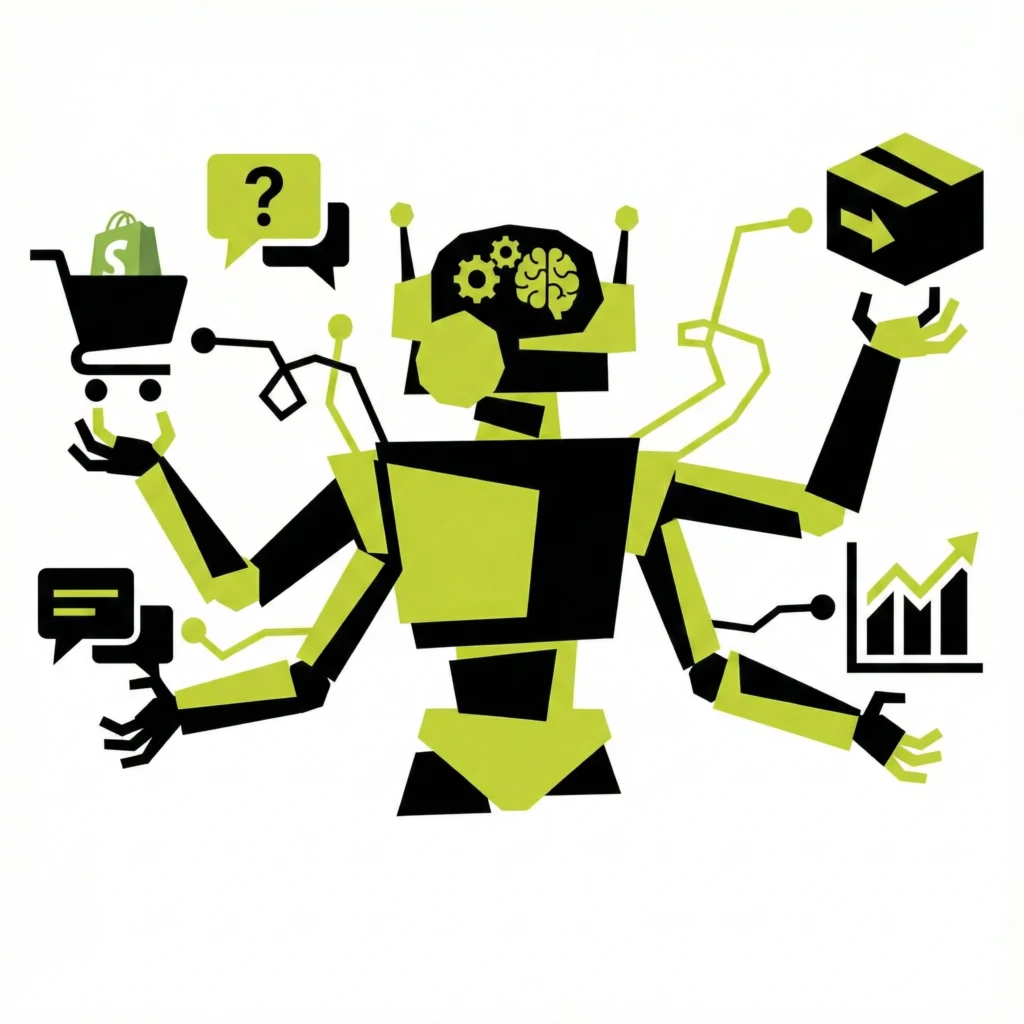
Wonderful, which raised a $100 million Series A in 2025, develops culturally aware corporate AI agents that speak with customers through voice, chat, and email. The company especially leads the “frontline experience” of brands in non-English markets.
Giga – Voice-based customer service AI
San Francisco–based Giga develops voice-driven customer-service agents for large companies and raised $61 million in 2025. Its agents function as a “voice-based experience face” that manages hundreds of thousands of calls with natural speech.
Yuma AI – Autonomous support agent for Shopify brands
Y Combinator–backed Yuma AI provides autonomous support agents integrated into help desks, especially for high-volume e-commerce brands. It is reported that the agent can resolve 50–80% of support requests entirely with AI.
Empathy dimension: The Alexa study
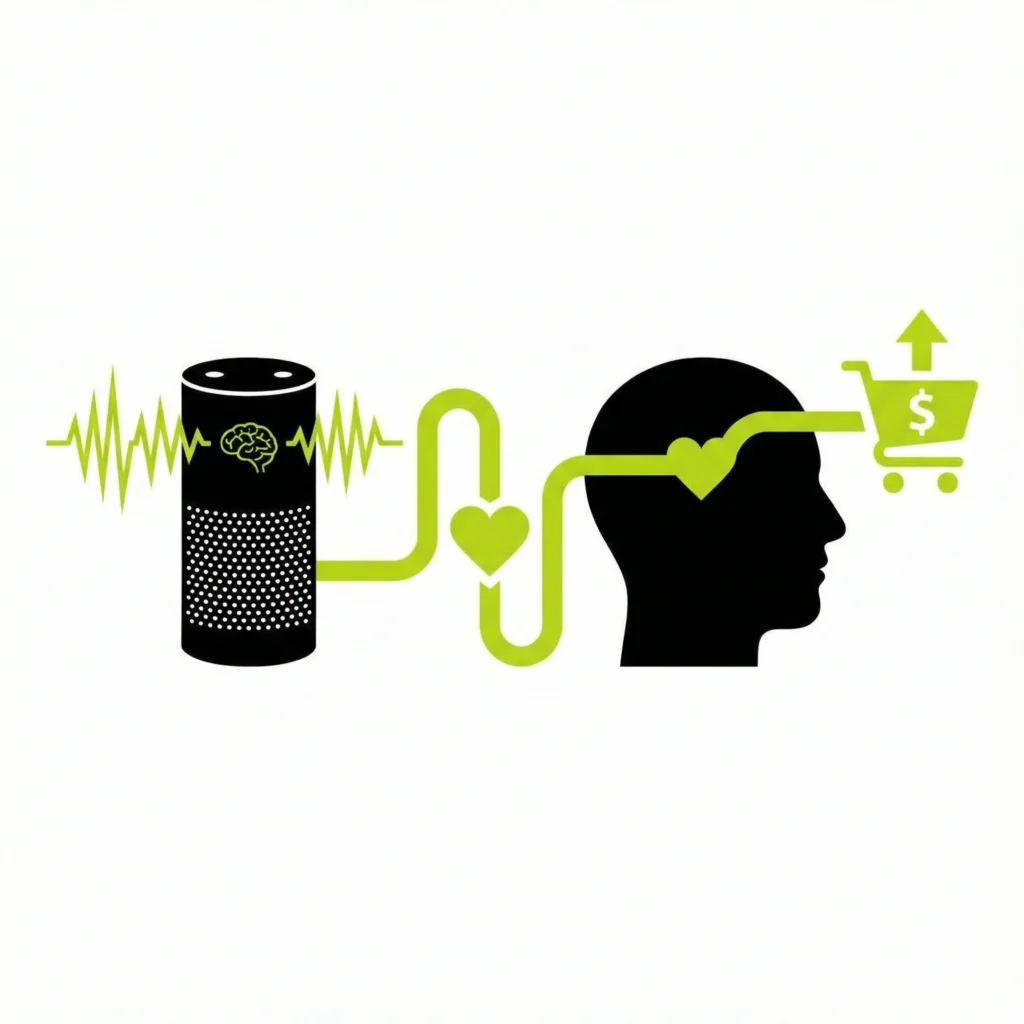
A 2024 Journal of Business Research study found that an empathetic version of Alexa significantly increased consumers’ trust, task delegation, and purchase intention compared to the standard version.
In the future, competitive advantage will belong not to those who make the best product, but to those who deliver the AI-enhanced experience surrounding the product in the most seamless, personal, and consistent way.
This picture reveals something clear: Customer service is no longer just a cost-reduction item; it is the brightest actor on the brand’s experience stage. AI interfaces both solve problems and carry the brand’s “character.”
5. Managerial Reality: Competing Not with the Product, but with the “AI Experience Around It”
AI agent market size Global market analyses from 2025 indicate that the AI-agent market, valued at around $5.4 billion in 2024, is expected to reach $7.9 billion in 2025 and exceed $200 billion by 2034 with a compound annual growth rate above 45%.
Revenue impact of personalization According to McKinsey’s personalization analysis, when executed well, personalization generally increases revenue by 10–15%, and depending on sector and execution quality, this effect can climb to 25%.
Customer expectations: personalization is now a “hygiene factor” Summaries citing 2024 McKinsey data show that over 70% of consumers expect personalized interaction from brands, while around 75% report discomfort when this expectation is unmet.
Therefore, marketing leaders must shift from segmentation-based “audience” thinking to dynamic, moment-by-moment experience generation for the individual. Experience is no longer a scenario designed in a PowerPoint deck; it is a process generated in real time before the user’s eyes.
6. The New Level in Experience Design: Simulated Behavior
AI not only produces the experience; sometimes, even before any campaign exists, it enables simulation of the reactions that experience will generate.
Artificial Societies, a Y Combinator–backed startup, raised $5.35 million in seed funding in 2025. The platform allows brands and institutions to test campaigns, communications, and product ideas on artificial societies composed of synthetic personas. Thus, it provides foresight into how content will be perceived before entering the real world.
This approach acts like a “wind tunnel” in experience design: Before launching the experience, the brand can simulate the possible reactions of different personas and the social interactions between them.
Conclusion: AI Is Now Writing the Experience — The Brand Is Merely Hosting It
In the past, people designed experiences; agencies and brand teams worked on concepts for weeks and months.
Today, a significant part of the stage is written by AI: the text, visuals, voice, dialogue, and even the flow of the narrative.
As consumers, with every brand interaction, we increasingly live a unique “moment”—a personal scene shaped algorithmically that no other user experiences in exactly the same way.
As Pine & Gilmore argue, while goods are tangible and services are processes, experiences are the memorable events that stay in the mind of the customer.
And today those memories are produced, increasingly, by machines together with humans.
The winners will be the brands that manage to code those memories in the most meaningful, most “human,” and most ethical way.