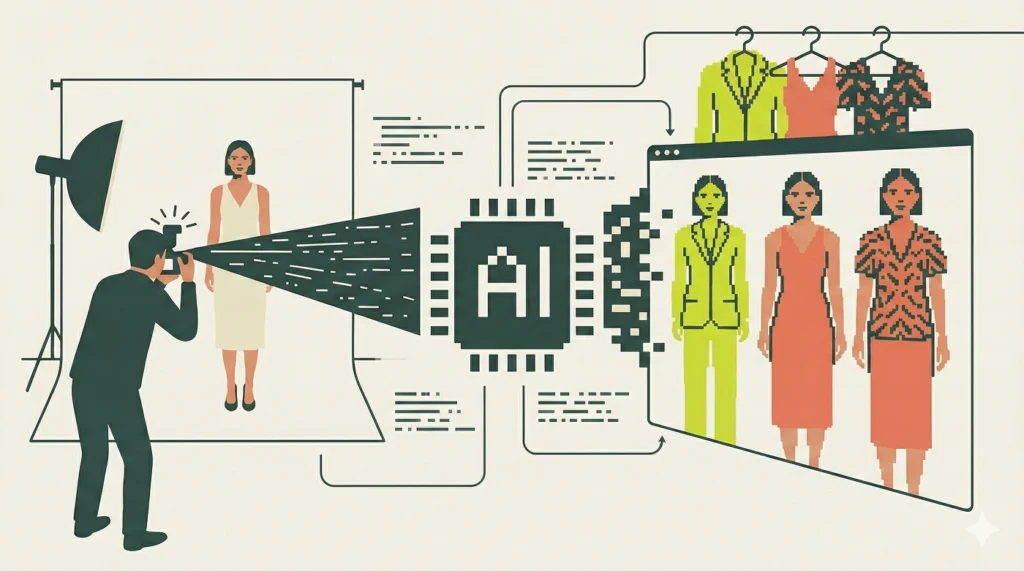
The global fashion industry is undergoing the most radical structural change it has seen since the Industrial Revolution. As of the last quarter of 2024 and the beginning of 2025, the industry’s giant players Inditex (Zara), H&M Group, and Zalando have integrated Generative AI technologies into the center of their operational processes, redefining traditional concepts of “photography,” “marketing,” and “design.” Based on Zara’s strategy of dressing real models with artificial intelligence, this report deeply analyzes brand differentiation in light of Philip Kotler’s “Marketing 5.0” and Seth Godin‘s “Purple Cow” theories, Ogilvy’s culture current approach, and the striking predictions (Agentic AI, Tariff Turbulence) in McKinsey’s “State of Fashion 2026” report published in November 2025. The report argues that fashion retail is not only digitizing but also moving to a new ontological plane of existence through a “human-machine” synthesis.
1. Introduction: The Silent Revolution in Fashion Retail and the Zara Effect
Fashion is, by nature, an industry based on speed and innovation. However, the change experienced in recent years is not just about the speed at which collections reach stores; this change is a fundamental rupture in the way the fashion image is created, consumed, and perceived. When Spanish retail giant Inditex’s flagship Zara announced that it had started using AI-generated visuals to showcase its products on e-commerce platforms, this was not just technology news, but a milestone for the creative industries.
Zara’s strategy is the result of a quest to optimize “content production speed” and “cost,” which are the traditional bottlenecks of the industry. In the traditional model, the photo shoot of a fashion collection requires the coordination of models, photographers, stylists, makeup artists, and set crews, physical travel, studio rentals, and long post-production processes. By transforming this process into a hybrid model with artificial intelligence, Zara has chosen the path of re-processing (rendering) photos of real models with different outfits in a digital environment. This move is part of Inditex’s vision to transform the concept of “fast fashion” into “real-time fashion.”

This transformation remained not limited to Zara but spread throughout the sector with competitors like H&M and Zalando adopting similar technologies even more aggressively. Zalando reported that it achieved savings of up to 90% in costs by producing 70% of its editorial content with artificial intelligence. However, this technological leap brings with it deep ethical debates, concerns about job losses for photographers, and the risk of the erosion of the perception of “reality.”
2. AI Strategies of Global Giants and Operational Transformation
2.1. Zara and Inditex: Artificial Intelligence as “Complementary Technology”
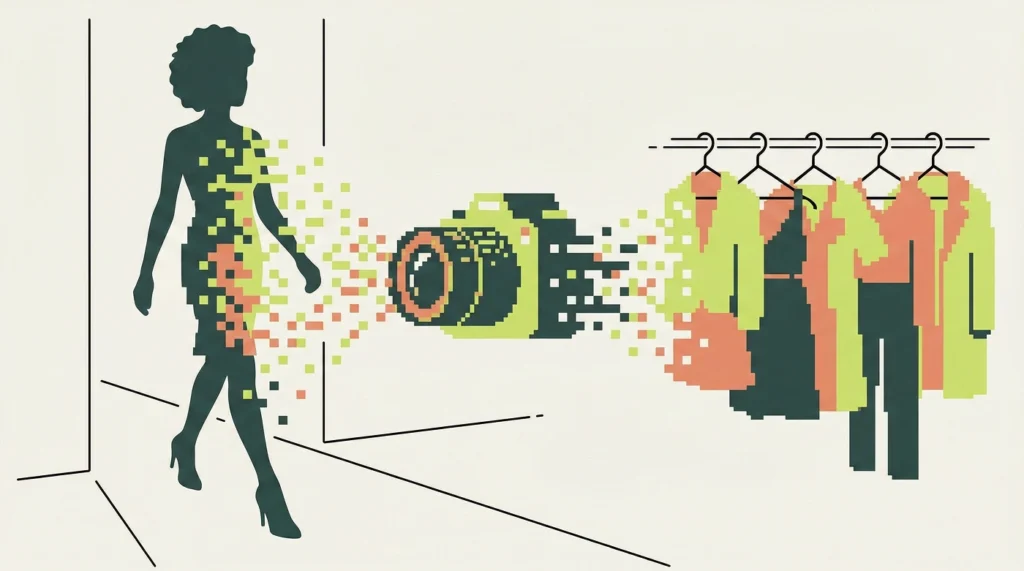
Zara’s approach to the use of artificial intelligence is built on a “co-pilot” model that accelerates the process rather than completely eliminating the human element. The company uses AI not to create models’ faces or bodies from scratch, but to digitally change outfits on existing photos of real models, optimize backgrounds, and correct lighting.
While defending this strategy, Inditex officials specifically emphasize the phrase “complementary to existing processes.” A company spokesperson states that collaborations with models continue, approval is obtained from models for any kind of editing, and payments are made in accordance with industry standards (industry best practice). This approach is an indication of Zara’s effort to protect its brand image. Indeed, Inditex Chairperson Marta Ortega has a personal interest in fashion photography and, as the daughter of the company’s founder Amancio Ortega, is trying to move the brand to a more “sophisticated” and “artistic” position. The fact that Marta Ortega hosts exhibitions of legendary photographers like Helmut Newton and Steven Meisel at the MOP Foundation in A Coruña shows that the brand is walking a delicate balance between art and technology.
However, information from the field indicates that this “complementary” role is beginning to turn into a “substitute” role in practice. An anonymous model speaking to the CityAM newspaper confirmed that Zara asked for permission to edit photos taken of them previously using AI to dress them in new products, and that they received payment as if they had done a new shoot in return. While this situation may seem like an opportunity for models to “earn money from where they sit” in the short term, in the long term, it creates the risk of a reduction in the number of physical shoots and unemployment for other professionals in the set environment (hairdressers, makeup artists, lighting technicians, assistants).
2.2. H&M and Digital Twins: The Rise of Virtual Assets
Swedish retail giant H&M has taken a more radical step than Zara, placing “Digital Twin” technology at the center of its marketing strategy. H&M created digital copies of 30 real models by performing high-resolution scans of them and has started using these copies on e-commerce sites and in social media campaigns.

The main motivation behind this strategy of H&M is “flexibility” and “scalability.” In a traditional shoot, it is impossible for a model to be in both New York and Tokyo on the same day. However, digital twins can exist in an unlimited number of locations with an unlimited number of outfits simultaneously. H&M’s Creative Director, Jörgen Andersson, defines this technology as a tool for “increasing creativity” and “enriching storytelling.” The company tries to alleviate ethical concerns by stating that the models continue to own the property rights of their digital twins and that the models earn income with every use of these twins.
H&M’s transparent use of the “Digital Twin” phrase in its campaigns is a critical step in terms of preventing the consumer from feeling deceived and complying with the transparency principles of the EU AI Act. Vanessa Moody, a model participating in the campaign, characterized this process as “professional, collaborative, and transparent,” stating that it sets a precedent for the future of technology.
2.3. Zalando: Hyper-Efficiency and 90% Cost Savings
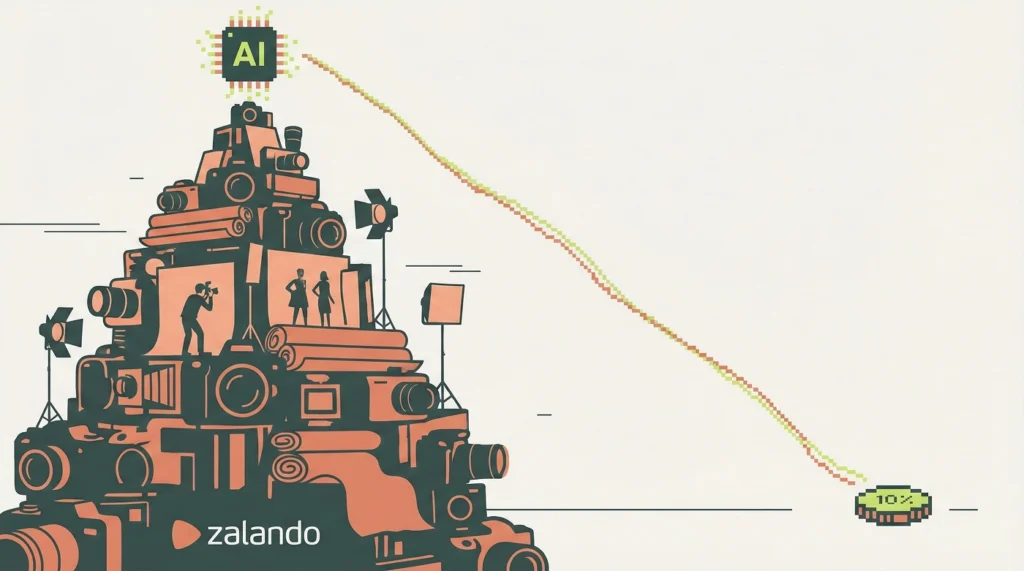
Europe’s largest online fashion retailer, Zalando, is the company that most clearly reveals the financial and operational results of AI integration. Zalando announced that it achieved a 90% reduction in costs by using artificial intelligence in fashion content production processes. This rate signifies a revolution on an industrial scale.
According to Matthias Haase, Zalando’s Vice President of Content Solutions, a campaign production process that takes 6 to 8 weeks with traditional methods has been reduced to 3-4 days with AI. This speed allows Zalando to respond to instant social media trends (micro-trends) like “Brat Summer” or “Mob Wife” in less than 24 hours with high-quality visuals. The most concrete example of the “Efficiency Unlocked” theme emphasized in McKinsey’s 2026 report is this operational success of Zalando.
The table below compares the cost structure of traditional photography versus AI-supported production based on Zalando’s data:
Table 1: Traditional Photography vs. Zalando AI Production Cost and Process Analysis
| Comparison Criteria | Traditional Fashion Production | AI-Supported Production (Zalando Model) | Change / Impact |
| Cost Per Visual | $150 – $500 (Average) | Single-digit dollar figures ($1 – $9) | ~98% Savings |
| Production Time | 6 – 8 Weeks (From Concept to Publication) | 3 – 4 Days | Striking Increase in Speed |
| Human Resources | Photographer, Lighting Technician, Stylist, Hairdresser, Makeup Artist, Set Assistants, Logistics Team | Creative Director, AI Prompt Engineer, 3D Artist | Downsizing in Team Structure |
| Logistics Requirements | Travel (Flight/Hotel), Studio Rental, Catering, Equipment Transport | High-Power Servers, GPU Rental, Software Licenses | Elimination of Physical Logistics |
| Product Management | Shipping physical samples to shoot location, ironing, returning | Digital sample (CAD) or a single reference product scan | Decrease in Carbon Footprint |
| Flexibility | Difficult to make changes after the shoot is done (requires reshoot) | Lighting, background, model pose can be revised unlimited times | Maximum Flexibility |
Data Source: Chief AI Officer Report and CityAM Analysis
Behind this success of Zalando lie advanced algorithms developed with ORENDT Studios that photorealistically simulate the drape of the fabric, the reflection of light on different textures (silk vs. cotton), and the wrinkles formed according to the model’s movement. This technology has overcome the “Uncanny Valley” problem, reaching a point where the consumer cannot distinguish the difference between artificial intelligence and reality. In a test conducted on Reddit, it was observed that users had difficulty distinguishing between the real photo on Zara’s website and those produced by AI, and even found the AI visuals more “realistic.”
3. Artificial Intelligence from the Perspective of Marketing Theory: Kotler, Godin, and Ogilvy
This technological transformation in the fashion industry is also shaking the cornerstones of marketing theory. Philip Kotler’s “Marketing 5.0” vision, Seth Godin’s “Purple Cow” theory, and Ogilvy’s “Culture Current” approach offer critical frameworks to make sense of this new era.
3.1. Philip Kotler and Marketing 5.0: Synthesis of Human and Machine
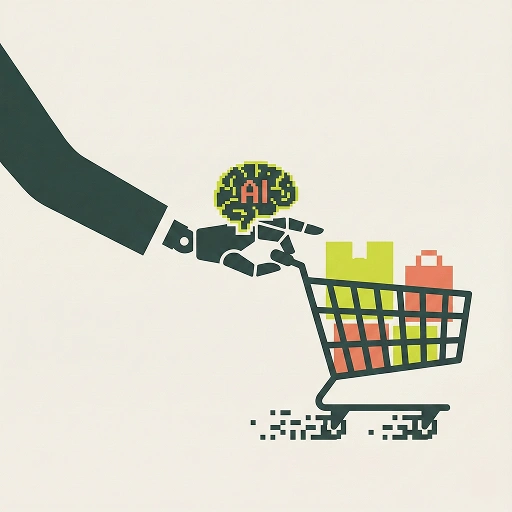
The doyen of the marketing world, Philip Kotler, defines technology as a lever that augments human capabilities in his work “Marketing 5.0.” However, McKinsey’s 2026 report takes Kotler’s definition a step further, introducing the concept of “Agentic AI.” Artificial intelligence is no longer just a prediction tool, but is rising to the position of an “agent” that decides and purchases on behalf of the consumer.
The practices of Zara and Zalando align perfectly with the three fundamental application areas defined by Kotler:
Predictive Marketing: Kotler states that artificial intelligence should analyze past data to predict future behaviors. Zara’s artificial intelligence scans social media posts, blogs, and forums to detect micro-trends that have not yet become mainstream and plans the production cycle accordingly. This is the realization of Kotler’s principle of “offering the customer what they want before they know they want it.”
Contextual Marketing: It is offering a personalized experience according to the consumer’s context in the physical and digital environment. Zalando’s “Algorithmic Fashion Companion” analyzes the user’s past purchases and style preferences, offering them a custom “digital boutique” experience.
Augmented Marketing: Technologies that increase the efficiency of human marketers. The fact that Zalando’s content creators now focus only on “aesthetic curation” and “style management” instead of dealing with logistics is a perfect example of augmenting human capability with machine power.
However, Kotler warns that technology cannot replace human empathy. If brands produce “soulless” and “emotionless” content with only a cost-oriented approach, they will have deviated from Marketing 5.0’s goal of “technology for humanity.”
3.2. Seth Godin and the “Purple Cow” Dilemma: The Banalization of Perfection
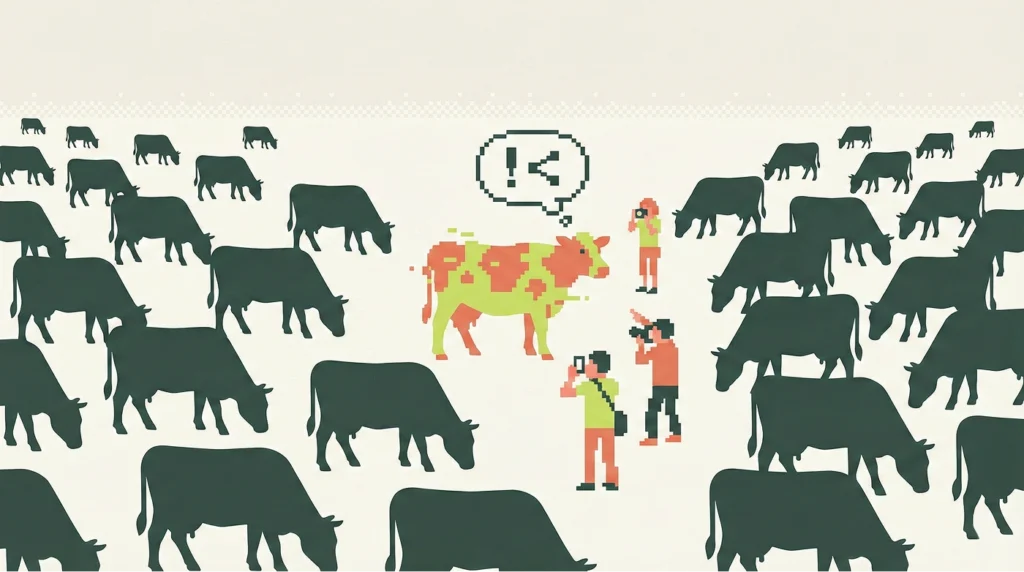
Seth Godin’s legendary “Purple Cow” theory argues that the only way to survive in today’s advertising clutter is to be “remarkable.” According to Godin, hundreds of brown cows grazing in a meadow attract no one’s attention; but a purple cow makes everyone stop, look, and talk about it.
In the age of AI, the fashion industry faces a major paradox in the context of Godin’s theory: The Risk of Homogenization. If Zara, H&M, Mango, and other brands use similar AI tools (Midjourney, Stable Diffusion, Firefly, etc.) trained on similar datasets, the results will be “flawless” but “identical.” Artificial intelligence is very good at perfecting the average, but it may struggle to create what is “outlier” and “risky.”
Moodley’s analysis states that “The New Purple Cow is no longer purple.” In a world where everyone is “purple” to attract attention (meaning everyone uses flawless AI visuals), what is remarkable might be “reality,” “imperfection,” and “naturalness.” As Godin says, “Safe is risky.” Producing risk-free, guaranteed, and cheap content with AI is a safe haven; however, the “Purple Cow” that will create brand loyalty is perhaps the human stories, behind-the-scenes footage, and genuine emotional connections that AI cannot produce.
3.3. Ogilvy and the 2025 Vision: Culture Current and Social-First Brands
Global advertising agency Ogilvy, in its strategy reports published for the year 2025, emphasizes that brands must now stop doing “Social Media Marketing” and switch to a “Social-First Brand Building” model.

According to Ogilvy’s “Social Trends 2025” report, social media is no longer just a distribution channel, but the brand’s existential ground. 53% of consumers get their news from social media, while 38% trust influencers more than traditional media. In this context, the “CultureCurrent” approach developed by Ogilvy envisions brands catching cultural trends instantly and responding to them in a “timely” and “authentic” manner.
Zara and Zalando’s AI strategies are tools that support precisely this “CultureCurrent” approach. When a TikTok trend (e.g., “Mob Wife Aesthetic”) emerges, while it takes weeks for a traditional brand to shoot and publish something suitable, Zalando can become part of the current by producing visuals suitable for this trend within 24 hours using AI. According to Ogilvy, brands should not be “Mirror Brands” (only reflecting culture) or “Shadow Brands” (visible but ineffective), but “Icon Brands” (shaping culture). Although AI gives brands this speed, the “Point of View” required to reach “Icon” status is still in need of human creativity.
4. Legal and Ethical Dimension: Copyrights, Regulations, and Human Rights
The AI revolution is progressing at a speed for which legal systems are unprepared, leading to discussions of new legal regulations, especially in the European Union and the United Kingdom.
4.1. EU AI Act and Transparency Requirement
The EU AI Act, the world’s first comprehensive artificial intelligence regulation, contains articles that directly affect the fashion industry. The law mandates the transparent labeling of content created or manipulated with artificial intelligence (especially those falling into the deepfake category).

H&M’s use of the “Digital Twin” watermark in its campaigns is a requirement of this legal compliance. The consumer’s right to know whether the model they see is a real human or a render (“Transparency Risk”) is one of the cornerstones of the law. Additionally, companies providing “General Purpose AI” (GPAI) models are required to disclose whether they comply with the copyrights of the data used to train their models and to respect the “opt-out” rights of copyright holders. According to a Clifford Chance report, fashion brands could also be held responsible for the legal status of the training data of the AI tools they use (Midjourney, Stable Diffusion, etc.).
4.2. Legal Status of Digital Twins and Immigration Law
The use of models’ digital twins reveals an interesting immigration law issue, according to an analysis by the Lewis Silkin law firm. According to the “Creative Worker Visa” rules in the UK, a model must perform “paid work” at certain intervals to avoid violating visa conditions. However, if the model is not physically present in the country but their digital twin “works” and generates income for a UK-based brand, it is unclear whether this work counts within the scope of the visa.
Furthermore, the usage rights of a model’s digital twin are generally determined by agency contracts. However, there are serious gaps regarding models’ rights to control which brands use their digital copies and in what context (for example, on a t-shirt containing a political message or on a platform with adult content) (“Right of Publicity”). Although H&M’s announcement that it protects models’ property rights is a positive example for the industry, it is a gesture of goodwill rather than a legal obligation.
4.3. Reaction of the Association of Photographers and the Creative Ecosystem
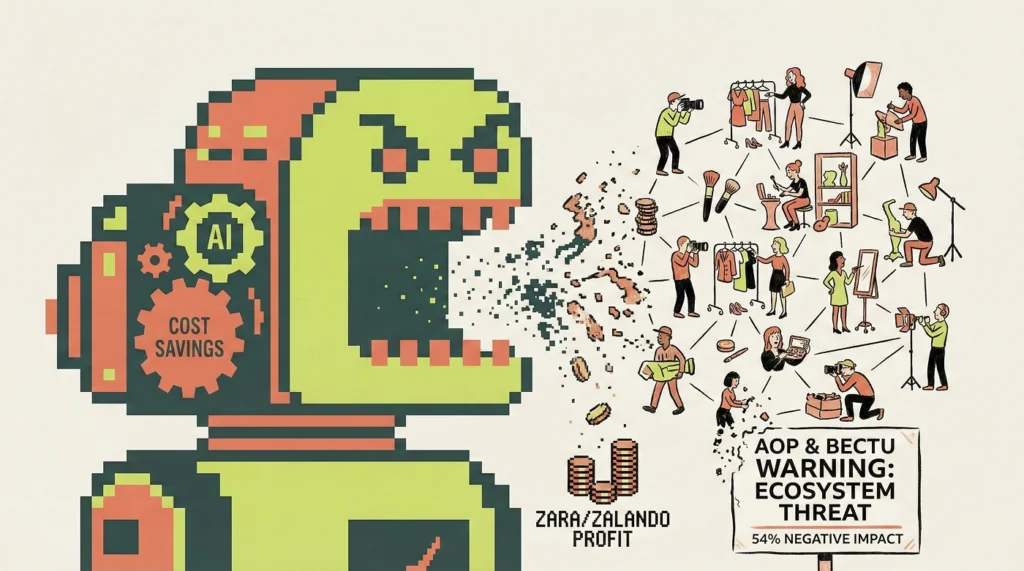
Isabelle Doran, CEO of the Association of Photographers (AOP) in the UK, states that the proliferation of artificial intelligence threatens not only photographers but an entire ecosystem (stylists, makeup artists, set designers, lighting technicians, rental companies). Every dollar that Zara and Zalando record as cost savings is actually characterized as a loss of income for the workers in this ecosystem. According to research by the union Bectu, 54% of workers in the fashion industry believe that the impact of AI on the sector will be negative.
This situation carries the “technological unemployment” debates to the fashion sector. Although some names like photographer Johnny Kangasniemi approach this optimistically, seeing AI as “a new tool in the artist’s toolbox,” the reduction in opportunities for entry-level photographers to build portfolios and gain experience could dry up the sector’s future talent pool.
5. The AI Revolution in Packaging, Sustainability, and Supply Chain
The artificial intelligence revolution is not limited to visuals on digital screens; it is also creating radical changes in the field of physical product packaging and logistics.
5.1. Sustainable Packaging Design and AI Platforms

However, the real innovation here goes beyond visual design. Artificial intelligence algorithms:
Space Optimization: By calculating the box size best suited to the product’s dimensions, it minimizes the problem of “shipping air” during transport and unnecessary cardboard usage.
Material Science: According to the Board of Innovation’s report, AI simulates and improves the durability of new-generation sustainable materials such as packaging made from mushroom roots (mycelium), algae-based biodegradable films, or water-soluble garment bags.
Personalization: Just like Nutella’s campaign designing 7 million unique packages, fashion brands can turn the “unboxing” experience into a marketing weapon by offering unique boxes designed by AI specific to each customer.
McKinsey’s “State of Fashion 2025” report emphasizes that consumers’ (especially the Silver Generation and Gen Z) sensitivity regarding sustainability has increased and brands are obliged to comply with “circular economy” principles. AI plays a key role in responding to this demand by reducing the carbon footprint in packaging.
6. Regional Powers and Insights from the Turkish Market: Trendyol, LC Waikiki, and Mavi
By combining its power in textile production with digital competencies, Turkey has become one of the important actors of the AI revolution.
6.1. Trendyol: AI-Supported Influencer Ecosystem

Turkey’s first “Decacorn,” Trendyol, uses AI and influencer marketing in an integrated model, especially in its expansion strategy to Gulf countries (MENA). In its strategic collaboration with TikTok, Trendyol used TikTok’s AI-supported “Smart+ Web Ads” solution to achieve:
26% increase in conversion rates,
21% decrease in cost per acquisition (CPA),
89% increase in return on ad spend (ROAS).
Trendyol’s influencer model is a performance-based (CPA) system managed through platforms like “Takefluence” and “Admitad.” AI analyzes which influencer should share which product at what time, managing micro and macro influencers (TrendFam) in an optimized ecosystem. This model is one of the most successful applications of Ogilvy’s “Social-First” approach in Turkey.
6.2. LC Waikiki: Virtual Design and Planning (VDP)
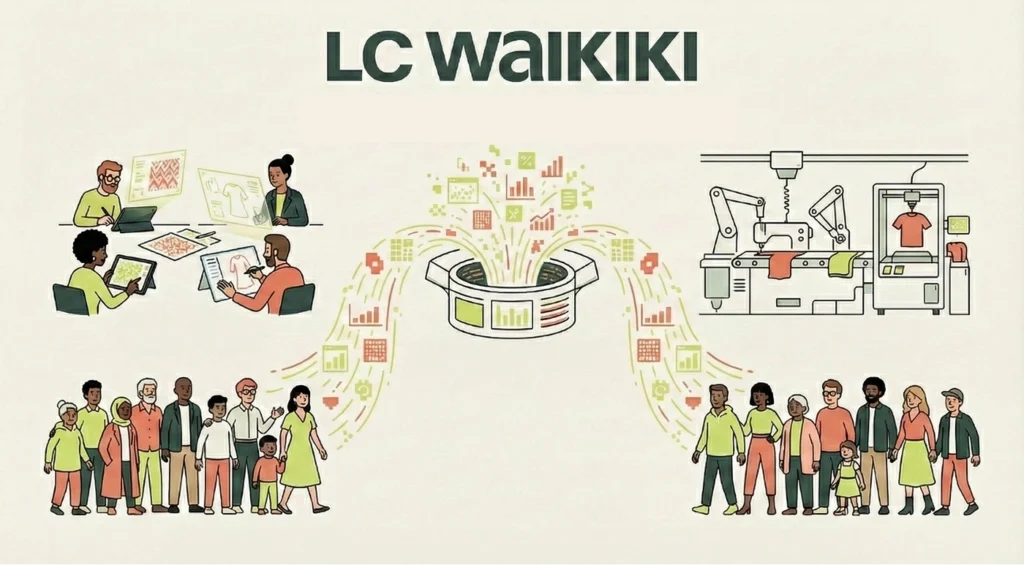
Acting with the vision “Everyone has the right to dress well,” LC Waikiki democratizes data and integrates it into design and production processes. By including external data scientists and developers in the process through “Datathon” events it organizes, the company develops AI models in areas such as “E-commerce Churn Prediction,” “Product Tagging with Image Processing,” and “Sales Prediction with Climate/Price Impact.”
Additionally, the potential to use design tools offered by platforms like Raspberry AI allows “fast fashion” brands like LC Waikiki to reduce their design cycles from 3-6 months to a few weeks. This is a critical competency for the brand to respond to changing consumer demands as fast as Zara.
6.3. Inventory Optimization: Mavi Jeans Case Analysis
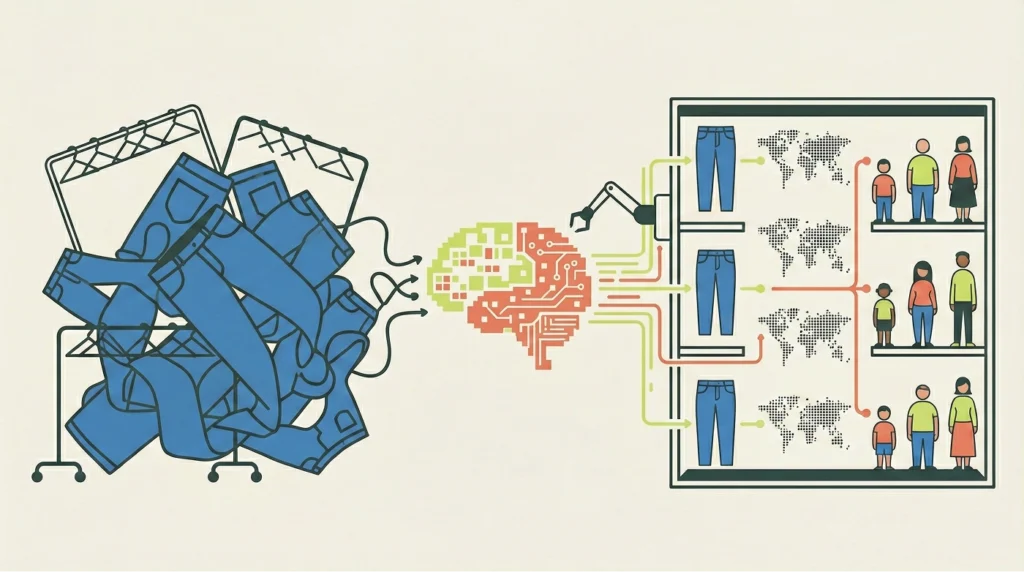
Optimization of the supply chain is of vital importance for profitability. Turkey’s global denim brand Mavi has revolutionized inventory management by collaborating with the AI company Invent Analytics.
The main problem Mavi faced was ensuring the right product was in the right place across 33 countries, 439 stores, and 4,500 points of sale. Traditional methods remained insufficient to manage regional demand fluctuations and size breakdowns. The AI system Mavi integrated:
- Makes over 20 million inventory decisions per day.
- Forecasts demand by analyzing sales history, store capacity, special days, and even weather data.
- Thanks to this optimization, Mavi achieved a 9.6% increase in revenue, increased stock turnover speed, and reduced markdown losses.
This case proves that AI is the “invisible hero” of fashion retail not only on the “image” side but also on the “business intelligence” side.
7. McKinsey 2026: “When the Rules Change” – Agentic AI and New Trade Maps

The “State of Fashion 2026” report, published on November 17, 2025, in collaboration with The Business of Fashion and McKinsey & Company, disperses the cautious atmosphere of the previous year for the industry and calls on executives to face a new reality where “Rules Change.” The report reveals that the fashion world is now struggling not only with economic fluctuations but with “systemic and permanent changes.”
7.1. From “Uncertainty” to “Challenging”: The Psychological Threshold Has Been Crossed
One of the most striking findings in the report is the shift in the mood of fashion executives. The word “Uncertainty,” which dominated reports in previous years, has been replaced by the concept of “Challenging” in the 2026 vision. Executives have now accepted that change is not a temporary storm but the “new normal.” While 46% of leaders surveyed predict conditions will worsen, 25% draw an optimistic picture by stating they see “pockets of opportunity.” In particular, the drop in pessimism regarding the Chinese market (from 41% in 2025 to 28%) is read as a signal of recovery in the Asian market.
7.2. “Agentic AI” and “The AI Shopper”
The most revolutionary determination under the technology heading of the report is the evolution of artificial intelligence from being “generative” to becoming “agentic.” According to McKinsey, in 2026 and beyond, fashion brands will be obliged to sell not only to human consumers but also to “Autonomous AI Agents” (The AI Shopper) acting on their behalf.
These “agents” will track prices, compare products, and even complete the purchasing process on behalf of consumers. This situation necessitates a radical change in e-commerce infrastructures. Brands are now obliged to develop GEO (Generative Engine Optimization) strategies to be “visible” and “preferable” by AI models, not just by SEO (Search Engine Optimization). The responses of AI chatbots are becoming the “new SEO.”
7.3. Workforce Rewired
Artificial intelligence has ceased to be a “competitive advantage” and has become a “business necessity.” The report emphasizes that fashion companies must redesign their workforces according to this technology (Workforce Rewired). While 35% of executives state that they already use Gen AI in content creation and customer service, it is predicted that automation in areas like finance and production, and Gen AI-supported productivity increases in marketing and sales, will be decisive. This means some roles becoming AI-focused, while creative teams shift to more strategic and analytical tasks (Efficiency Unlocked).
7.4. Tariff Turbulence and Supply Chain
The biggest macro-economic warning of the McKinsey 2026 report is the redrawing of the global trade map by US tariffs (Tariff Turbulence). Increasing customs duties and trade barriers are forcing brands to change their sourcing and increase efficiency. This situation harbors both risks and opportunities for countries with “nearshoring” advantages like Turkey. A period is foreseen where large suppliers will survive by investing in automation and digitalization (Efficiency Unlocked), while small players will struggle under increasing pressure.
7.5. Recalibration of Luxury and “Jewelry Sparks”
After a tough year for luxury consumption in 2025, it is stated that in 2026, the luxury segment will abandon the “price-focused growth” strategy and return to the foundation of “Creativity and Craftsmanship” (Luxury Recalibrated). To regain customer trust, luxury brands will focus on product quality and storytelling instead of price increases.
The shining star in this context is the Jewelry (Jewelry Sparks) category. Defying the slowdown in luxury apparel, consumers’ search for “lasting value” and the “self-gifting” trend are enabling the jewelry category to grow faster than all other fashion categories (4 times the volume of apparel).
7.6. Other Critical Themes: Smart Frames and Resale Sprint
Smart Frames: 2026 will be the year of “smart glasses” in wearable technology. Stylish devices equipped with multimodal AI will combine fashion and technology with the potential to create a $30 billion market by 2030.
Resale Sprint: Consumers seeking value in the face of price increases will continue to turn to the second-hand market (Resale). For brands, resale is no longer a “side project” but a strategic necessity that supports the revenue model and strengthens brand perception.
The Well-being Era: Consumers are spending not just to “look good,” but to “feel good.” Fashion brands will be able to create loyalty to the extent that they can integrate into this “wellness” trend.
8. Strategic Conclusion and Recommendations: Towards Fashion 5.0
In light of the findings of this report, the following strategic roadmap is suggested for fashion brands, agencies, and retailers:
Prepare for Agentic AI: Your brand’s e-commerce infrastructure must appeal not only to humans but also to AI bots that will shop on their behalf. Your product data must be rich enough for algorithms to “read” and “understand.”
Make Transparency a Brand Value: Compliance with the EU AI Act is not just a legal obligation, but a construction of trust. Honestly tell your consumer which visual is real and which is AI.
Future-proof Your Legal Infrastructure: Update your model contracts to cover digital twin rights, usage periods, and limitations.
Make Supply Chain and Packaging Smart: Sustainability is not just PR material. Reduce your carbon footprint and costs with AI-supported packaging design and inventory management.
Synchronize with Culture: As Ogilvy says, social media is not a showcase, but a living space. Catch cultural trends instantly using AI, but do not neglect to add “human warmth” when producing your content.
In conclusion, the fashion industry has stepped into a new universe through the door opened by Zara. The winners in this universe will be those who best synthesize the cold efficiency of algorithms with the warm chaos of human creativity.