
Executive Summary: The Third Wave of Digital Marketing
The global marketing ecosystem is undergoing one of the most radical structural transformations in modern economic history. The paradigms defined by Philip Kotler during the transition from “Marketing 1.0” (Product-Centric) to “Marketing 5.0” (Technology for Humanity) are being rewritten today as artificial intelligence assumes the role of a “cognitive intermediary.” The deterministic and list-based information retrieval model offered by traditional search engines is giving way to the probabilistic, synthesized, and direct-response-oriented model offered by Generative AI systems. This report examines the concept of “Generative Engine Optimization” (GEO) not merely as a technical optimization process, but as a strategic marketing discipline.
The emergence of large language models (LLMs) has initiated a new search engine paradigm (generative engines, GEs) that utilizes generative models to summarize information and respond to user queries; these systems are rapidly replacing traditional search engines like Google and Bing. While this shift enhances user utility, it poses a significant challenge for content creators, as Generative Engines potentially reduce organic traffic—and consequently website visibility—by providing precise and comprehensive answers directly.
The fundamental thesis of this report is that it is now a necessity for brands to move beyond being “findable” and achieve the status of being “recommendable” by AI models. This thesis is substantiated by Adobe Analytics’ 2025 data: AI-driven e-commerce traffic has shown an 805% increase compared to the previous year. This data proves that the shift in consumer behavior is not a prediction, but a realized market reality.
The following study examines this new ecosystem across four main axes:
The new economic order created by Generative Engines and a deep analysis of Adobe data,
The theoretical and technical framework of GEO based on Princeton and Georgia Tech research,
20 pioneering GEO startups that provide competitive advantage in this field and their technological infrastructures,
Strategic managerial implications for marketing executives (CMOs).
1. Transition from the Search Economy to the Answer Economy
1.1. Paradigm Shift: From Librarian to Consultant
In traditional marketing theory, the act of “Search” represented the information-gathering stage in the consumer’s purchasing decision process. Search engines like Google and Bing assumed the role of a “librarian” in this process, directing the user to the source of information (the website).
However, the years 2024 and 2025 have been a turning point where this relationship has been shaken to its core. Large Language Models (LLMs) and Generative Answer Engines (ChatGPT, Perplexity, Claude, Gemini) respond directly like a “consultant” by synthesizing information rather than listing sources for the user.

This shift fundamentally alters Kotler’s definition of “Customer Value.” While in traditional SEO, value meant presenting the web page most relevant to the user’s query, in GEO, value means presenting verified and synthesized information that minimizes the user’s cognitive load. Consumers no longer want to “click links” and navigate through pages; they want to receive the most accurate, fastest, and reliable answer to their question within a single interface. Although this situation brings about a “Zero-Click” future and the risk of traffic loss for websites, it simultaneously offers the opportunity to reach high-intent users.
Marketing in the digital age is undergoing a radical transformation, moving away from the traditional “librarian” role and reshaping the concept of Customer-Perceived Value. Artificial Intelligence (AI), and specifically Generative AI (GenAI), stands out as a major change agent with its ability to create advertising messages and marketing plans, enabling businesses to act like a “consultant” by offering directly synthesized answers to customers instead of listing sources.
While customer value is defined as the difference between all benefits received by the customer and all costs incurred (including monetary, time, energy, and psychological costs), one of the main goals of Marketing 5.0 is to create a “frictionless” Customer Experience (CX) through technology that minimizes these costs—specifically the customer’s cognitive load.

1.2. Pazar Verileri ve Ekonomik Gerekçeler: %805’lik Kırılma Noktası
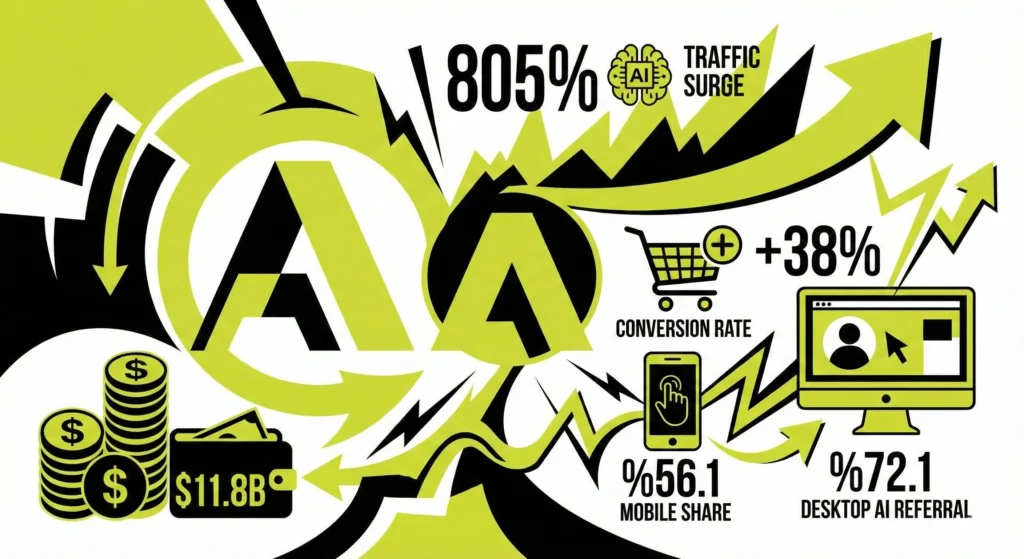
Data provided by Adobe Analytics covering November 2025 serves as a “wake-up call” for marketing strategists. When the visuals and supporting data subject to the report are examined, it is evident that the impact of artificial intelligence on e-commerce has reached a dominant, rather than marginal, scale.
Table 1: Adobe Analytics 2025 E-Commerce and AI Traffic Analysis
| Metric | Value / Change | Strategic Implication |
| AI Traffic Growth (YOY) | 805% | Consumers are using AI assistants, not the search bar, for product discovery. |
| AI-Driven Conversion Rate | +38% (vs. non-AI sources) | Users coming via AI arrive to “buy,” not to “browse.” |
| Total Online Spending (US) | $11.8 Billion (Black Friday) | Digital channel growth continues despite economic stagnation. |
| Mobile Device Share | 56.1% (Revenue Based) | The AI experience is not limited to desktop; it is integrated with mobile wallets. |
| Desktop AI Referral | 72.1% | Complex product research (B2B and High-Value B2C) is still conducted with AI on desktop. |
In light of this data, it is clear that the 805% increase is not merely volume growth, but a “behavioral migration.” The consumer utilizes artificial intelligence as a “validation mechanism” to reduce uncertainty in the decision-making process. If a brand is not included in the recommendation set of these AI assistants (ChatGPT, Gemini, etc.), it fails to enter the consumer’s consideration set entirely.
1.3. The Trust Economy and Algorithmic Authority
In marketing management, “Brand Trust” has historically been built through human relationships, corporate communication, and social proof. However, in the GEO era, trust has now become an output generated by algorithms, not humans. The consumer directs the question “Is this product good?” not to a sales representative or an advertisement, but to an AI they believe to be “objective.”
The critical point here is that artificial intelligence is not truly objective; its responses are shaped by training data, source selection, and retrieval mechanisms. This is exactly where the essence of GEO emerges: Ensuring the brand is encoded as a “trusted source” within these mechanisms.
This situation is the digital equivalent of Peter Drucker’s dictum, “The aim of marketing is to make selling superfluous.” Because once a brand begins to be recommended as the “best solution” by artificial intelligence, it does not have to sell itself anew each time; the authority has been conferred by the algorithm.

This transformation also shifts brand trust from vertical corporate communication to the horizontal social influence emphasized by Kotler in Marketing 4.0. Consumers are now more wary of brand messages and much more receptive to the influence of family, friends, followers, and communities (the f-factor). The growing trustworthiness of platforms like Yelp or TripAdvisor is evidence of this.
Algorithmic authority is the modern pathway into this new environment of trust. The capacity to analyze big data and behavioral models to recommend the most accurate product to the customer at a “segments of one” level is fundamentally altering the customer journey. Accurate recommendations offered by AI reduce search costs and, as targeted by Marketing 5.0, can transform the customer from merely a satisfied user into a voluntary advocate of the brand.

Consequently, when a brand is encoded as the “best solution” by algorithms, its dependency on expensive advertising investments decreases; the transition from the Ask stage directly to the Act and Advocate stages in the customer journey accelerates. For precisely this reason, GEO has become the new language of modern brand authority.
2. Theoretical Framework and GEO Mechanics
2.1. Academic Foundations of GEO: The Princeton and Georgia Tech Approach
The concept of Generative Engine Optimization (GEO) was introduced to the literature through a collaborative study by researchers from Princeton University, Georgia Tech, the Allen Institute for AI, and IIT Delhi. This study outlines the roadmap for the transition from the deterministic rules of search engine optimization (SEO) (such as keyword density and number of backlinks) to the probabilistic nature of generative engines.
The most striking finding of the research is that the use of information density and authoritative references (citations, quotations) can increase the visibility of brands in AI responses by 30-40%. Just as “keyword stuffing” is detrimental in traditional SEO, “evidence stuffing” is beneficial in GEO.

2.2. Nine Strategic GEO Variables
Drawing from academic studies and early-stage field applications, at MARQORA, we identify nine fundamental variables that influence GEO success. These variables serve as a prescription for marketing executives to restructure their content strategies:
1) Authoritative Citations
Authoritative citations are among the most powerful optimization tactics, increasing visibility by 30–40%, as LLMs perceive them as a signal of “verifiability.” Links to .gov, .edu domains, academic articles, or statistical institutes embedded in the content reduce the model’s “hallucination risk,” enabling it to flag that source as a safe reference. Therefore, adding citations in GEO is not merely a stylistic preference, but a structural necessity that generates a direct leap during the re-ranking stage of the RAG (Retrieval-Augmented Generation) pipeline.

2) Statistical Evidence
Quantitative data increases visibility by 30–40% as it stands out within the LLMs’ “information density” criterion. Numbers, date ranges, percentages, and currencies generate “high-signal” tokens that enable the LLM to make inferences more securely. Thus, incorporating statistical data is not simple ornamentation; it is a core optimization mechanism that directly influences how RAG systems select content.

3) Quotation
Direct quotes from experts allow content to distinguish itself from competitor texts by creating “unique token clusters” detected by LLMs. The Princeton study indicates that this method increases visibility by 30–40% and that quotes are interpreted by the model as an E-E-A-T-like signal of expertise. Therefore, expert opinions are not just indicators of authority; they are strategic content elements that provide “high information gain” in the re-ranking layer of RAG.

4) Simplification
Simplifying complex concepts helps LLM tokenization work more efficiently and facilitates easier “chunking” of the content. Simple, direct, and metaphor-free explanations create “high-clarity” answer snippets that RAG systems can easily retrieve and present to the user. Thus, the content both increases semantic proximity and raises the probability of being preferred by the model by reducing the risk of incorrect inference.

5) Fluency & Structure
Proper hierarchy (H1–H2–H3) and fluent language can facilitate the correct understanding of content structure by LLMs, potentially providing a 15–30% improvement in visibility. Clear headings, Q&A blocks, and logical flow allow RAG to segment the content with higher confidence. Therefore, while structural fluency is a complementary factor in GEO, it is not as decisive as statistics, quotes, and citations.

6) Unique Vocabulary
Industry-specific terms and original concepts ensure the content acquires a sharper semantic position in the vector space. Unique tokens help the model distinguish the content from other superficial and repetitive texts. Thus, the content generates a “high information gain” signal and increases the chance of being preferred in the re-ranking stage.

7) Technical Terms
Correctly used technical jargon indicates to the LLM that the content originates from a source with a high level of expertise. Technical concepts provide more accurate conceptual proximity in the vector space and help the model place the content within the high authority domain. Therefore, technical terms play a significant role not just in style, but in GEO’s “expertise signal” layer.

8) Entity Density
The clear definition of brand, product, concept, and person names enables LLMs to map the information nodes (entities) in the content more strongly with the Knowledge Graph. High entity density optimizes vector proximity by increasing semantic neighborhood coverage. This raises the probability of RAG evaluating the content as a “high-confidence chunk” that is more suitable for the search intent.

9) Sentiment Alignment
When the tone of the content is aligned with the expected emotional context of the query, the LLM evaluates the text as a “correct contextual match.” Negative or overly subjective tones can lower the model’s trust signal, causing the content to be eliminated during re-ranking. Therefore, sentiment alignment is a semantic alignment factor that enhances visibility.

2.3. Black Box Optimization and Probabilistic Marketing
Traditional SEO is a process of “reverse engineering” that attempts to decipher the algorithm’s rules. However, Generative AI models (LLMs) operate as a “Black Box.” It is impossible to know with certainty exactly which output (response) a given input (content) will produce. Therefore, GEO is not a deterministic process, but a probabilistic one.

For marketing executives, this implies an evolution of strategy from “adhering to rules” to “managing probabilities.” The goal is to maximize the probability of the brand’s “retrieval” when an AI generates a response. This is only possible if the brand’s digital footprint creates a dominant “pattern” within LLM training datasets and RAG processes.
Michael Porter’s competitive strategy must be revised in the age of artificial intelligence. In this new era, the “Threat of Technological Advancement” and the “Threat of Partnerships” are added to Porter’s Five Forces. A brand can be pushed out of the market by competitors who establish data partnerships with AI platforms (e.g., the Reddit-Google agreement). Therefore, GEO is not merely content optimization; it is also a strategic data positioning war.
3. GEO Ecosystem and Analysis of 20 Pioneering Startups
These new market dynamics have given rise to a rapidly growing “MarTech” (Marketing Technology) vertical designed to help brands manage their AI visibility. Detailed below are 20 pioneering GEO startups operating in this space, each offering a unique value proposition. These initiatives are the modern practitioners of Kotler’s “Marketing Information System” concept.
Category 1: Enterprise Analytics and Visibility Intelligence
English: Companies in this category operate as the “control room” for large-scale enterprises, enabling them to track sophisticated metrics such as “Share of Model” and “Answer Probability.” Unlike basic monitoring tools, these platforms provide granular data on how different LLMs ingest, process, and retrieve brand information, serving as the foundational layer for any serious GEO strategy.

1) Brandi AI
Value Proposition: GEO Focused on Cultural and Linguistic Localization.
Brandi AI distinguishes itself in the GEO market through a “cultural intelligence” layer. It analyzes not only whether a brand appears in AI responses but also how it is perceived across different geographies and languages. Its localized analysis capability, offered in over 10–15 languages (Arabic, Japanese, Spanish, etc.), is critical for global brands managing their “glocal” (global + local) strategies.
Aligned with Philip Kotler’s emphasis on “Cultural Context in Marketing,” Brandi AI captures the nuance between the meaning of a query in Los Angeles and its meaning in Tokyo. The platform enables brands not merely to translate, but to gain authority within AI models by producing content aligned with cultural codes. It is expanding into the B2B market through an agency partnership program.
2) Profound
Value Proposition: Enterprise Compliance and In-Depth Market Analysis.
Profound is a SOC 2 Type II compliant AI visibility / GEO platform focused on the enterprise segment. It monitors brand visibility, citations, and sentiment tone across major answer engines such as ChatGPT, Perplexity, Google AI Overviews/Mode, Gemini, Copilot, Grok, Meta AI, and DeepSeek, while analyzing the questions and volumes users direct to these systems via its Conversation Explorer feature. Its pricing follows a premium structure, starting with plans in the $100–$500 range and extending to custom packages for enterprise customers.
From a managerial perspective, Profound provides “strategic intelligence” to marketing departments. It identifies areas where the brand lags behind competitors (gap analysis) and determines which prompts carry the highest commercial value. Employing a premium pricing strategy, it offers monthly packages starting from $100–$500+ depending on the plan, scaling up to thousands of dollars in the enterprise segment.
3) AthenaHQ
Value Proposition: Automation and Content Generation Integration.
AthenaHQ is a GEO platform that monitors brand visibility across multiple AI answer engines (e.g., ChatGPT, Perplexity, Google AI, etc.) and offers content and optimization recommendations based on this data. Its focus is on converting monitoring outputs into actionable tasks for content teams.
Aligned with Marketing 5.0 principles, AthenaHQ promotes “human-machine collaboration.” The platform identifies topics where the brand is lacking and automatically generates content drafts to fill these gaps. Through e-commerce integrations (Shopify), it attempts to measure the direct impact of AI visibility on sales.
4) Rankscale
Value Proposition: Technical Scoring and Transparent Reporting.
Rankscale evaluates brands’ digital assets using a metric called the “AI Readiness Score.” This approach transforms GEO from an abstract concept into a measurable and auditable technical performance.
The platform features an interface specifically designed to facilitate the transition to GEO for SEO-native teams. It audits whether a site’s technical infrastructure (schema markup, robots.txt) is optimized for AI crawlers. With its affordable structure, it aims to penetrate the market base, and it is a favorite among analysts due to its flexibility regarding data export.
5) Scriptbee
Value Proposition: Operational Efficiency for Agencies and Multi-Brand Management.
Scriptbee is an “execution” platform that not only provides data but offers prescriptions on “how” to use it. Designed specifically for agencies, Scriptbee is a GEO/SEO execution platform that facilitates multi-client/domain management. By integrating with SEO tools like Semrush, it presents classic SEO data alongside AI visibility data in the same dashboard, helping to understand user intent by providing analysis at the prompt level.
Adopting Kotler’s “Integrated Marketing Communication” principle, Scriptbee unifies traditional SEO data (Ahrefs, Semrush integration) with GEO data in a single dashboard. This allows brands to manage “search” and “answer” strategies as a unified whole rather than in silos. Its analytical capability at the prompt level provides depth in understanding user intent.
Category 2: Accessibility & SMB Focused Solutions
This segment represents the democratization wave of the Generative Engine Optimization ecosystem. Startups in this category are engineered to lower the technical and financial barriers to entry, making high-level AI visibility intelligence accessible not just to Fortune 500 conglomerates but to Small and Medium-sized Businesses (SMBs) and agile marketing teams. Unlike the complex, data-heavy architectures of enterprise tools, platforms in this category prioritize user experience (UX), rapid deployment, and clear, visualized insights. They operate on the fundamental philosophy that every brand, regardless of its scale or budget, deserves to know how it is being represented—or ignored—by the AI algorithms that now shape consumer decisions.

6) Peec AI
Value Proposition: Visualized Data and Ease of Use.
Peec AI converts complex GEO data into simple and understandable dashboards, enabling marketing executives to see the “big picture.” It is the choice of Mid-Market businesses due to its price/performance balance and user-friendly interface.
The platform offers visual tools that benchmark brand visibility against competitors. It indicates which prompts trigger the brand and which sources (websites, articles) are referenced by the AI. However, rather than in-depth technical optimization recommendations, it is focused on monitoring and reporting.
Aligned with Byron Sharp’s approach that “visibility is the foundation of competition,” Peec AI centers on measuring the brand’s accessibility in AI models. Nevertheless, instead of deep technical optimization or content generation, it focuses on monitoring, benchmarking, and reporting; meaning it is positioned in the “strategy-informing” layer of GEO.
7) Otterly.ai
Value Proposition: Entry-Level Monitoring and Speed.
Otterly.ai is a tool operating on the “Startups for Startups” logic, offering quick setup and simple monitoring features. It is a low-cost entry point for small teams wanting to track brand presence on Google AI Overviews and ChatGPT.
Its Brand SWOT analysis (Strengths, Weaknesses, Opportunities, Threats) feature forms the basis of strategic planning. Instead of complex datasets, Otterly focuses on providing clear answers to the question, “Is my brand being mentioned?”
8) Kai Footprint
Value Proposition: Education and Community-Led Growth.
Kai Footprint is positioned not just as software, but also as a “GEO Education Platform.” It aims to educate and raise awareness in the market through free brand reports and weekly newsletters. This strategy is a successful example of “Content Marketing.”
On the analytics side, it measures “how” the brand is perceived by AI models (perception). For example, it answers the question, “What does AI think about our product?” This serves as a qualitative feedback mechanism for brand managers.
9) Scrunch
Value Proposition: Basic Monitoring and Bot Traffic Analysis.
Scrunch differentiates itself by analyzing the behavior of AI bots on the website. By answering the question “Which AI crawler visited my site?”, it provides data to technical teams.
The platform is monitoring-focused and limited regarding optimization recommendations. However, providing transparency on AI-driven traffic and bot activities is valuable for technical SEO teams. With its “Agent Experience Platform” (AXP) vision, it aims to create websites specifically for AI agents in the future.
Despite its simple interface, due to its pricing policy (No Free Trial, High Entry Cost), it appeals to SEO teams with budgets rather than micro-businesses.
Category 3: Content & Reputation Management
While the previous categories focus on measurement, this category focuses on intervention. Companies in this group address the “garbage in, garbage out” problem of AI models. They provide the tools necessary to manage the quality of the content fed into the ecosystem and, crucially, the “narrative” that AI models construct about a brand. In the GEO era, Public Relations (PR) is no longer just about managing journalists; it is about managing the training data and inference patterns of Large Language Models to prevent “hallucinations” and ensure brand integrity.

10) Brandlight
Value Proposition: Reputation Protection and Crisis Management.
Brandlight utilizes GEO as a “Public Relations” (PR) tool. It monitors the “narrative” generated by AI about the brand and detects potential “hallucinations” or negative rhetoric.
The detection of “Narrative Drift” checks whether the brand’s message is being distorted by AI. In times of crisis, it identifies the source of negative content, allowing for intervention. This serves as critical insurance for corporate reputation management.
11) Goodie (NoGood)
Value Proposition: Hybrid Service and Action-Orientation.
Goodie is a hybrid solution combining software and service, developed by the renowned growth marketing agency NoGood. With its “Outreach Agent” feature, it automatically sends emails to acquire the “external citations” (backlinks) necessary for the brand to appear in AI responses.
This proactive approach transforms Goodie from a mere analysis tool into a “growth engine.” In competitor analysis, it reveals the sources empowering competitors, enabling the development of strategic counter-moves. It doesn’t just analyze; with the ‘Outreach Agent’ module, it conducts autonomous negotiations to get your brand featured on authoritative sites.
12) Evertune
Value Proposition: E-Commerce and Product-Centric Visibility.
Evertune is designed specifically for retail brands. It analyzes specific prompts consumers use during product research and measures the “recommendation rate” of the brand’s products in these searches.
The platform possesses a comprehensive database called the “AI Brand Index.” With over 1 million monthly prompt analyses, it provides data with high statistical reliability. By showing how product attributes (price, quality, durability) are perceived by AI, it also provides insights to product development teams.
13) Writesonic (GEO Platform)
Value Proposition: Integration of Production and Optimization.
Writesonic has carried the advantage of being a powerful AI content generation tool into the GEO space. It optimizes content for artificial intelligence engines simultaneously as it generates it. This consolidates the production and optimization processes, providing cost and time savings.
The “AI Article Writer” feature creates articles compliant with GEO principles (citations, structure, data). Additionally, it possesses technical analysis tools that show how AI crawlers scan the site.
14) BrandWell (Eski adıyla Content at Scale)
Value Proposition: SEO and GEO Compatible Long-Form Content.
BrandWell focuses on “undetectability” and “authority” in content production. The content it produces is optimized for both Google algorithms (SEO) and Generative Engines (GEO).
Its “RankWell” technology analyzes the semantic depth and E-E-A-T (Expertise, Authoritativeness, Trustworthiness) signals of the content. By integrating the brand’s own data and insights into the content, it ensures differentiation from generic AI outputs.
Category 4: Transformation of Traditional Players (Incumbent Pivot)
This group consists of established market leaders and traditional SEO giants who are adapting their existing infrastructure to the age of Generative AI. Rather than building from scratch, they leverage their massive user bases and data archives to offer integrated GEO solutions, allowing brands to manage both traditional search and AI visibility from a single platform.

15) Semrush (AI Toolkit)
Value Proposition: Integrated SEO and GEO Management.
Semrush, one of the leaders in the SEO market, pursues a strong defensive strategy by integrating GEO features for its current user base. With its “AI Overview Tracking” feature, it tracks the brand’s position in Google’s AI summaries.
The biggest advantage for marketers is the ability to view next-generation metrics within a familiar interface. The Position Tracking tool now reports not only web rankings but also the status of presence in AI snippets.
16) Yext
Value Proposition: Structured Data and Knowledge Graph Management.
Yext enables brands to manage their digital information (address, phone, product attributes) from a single center. In the GEO era, this is vitally important for ensuring the brand’s “Knowledge Graph” data is read correctly by AI models.
Yext’s thesis is that “Structured data is the language of AI.” By organizing their data in schema markup format, brands ensure that AI models accept this data as fact. This is the most effective method for reducing the risk of “hallucinations.”
17) First Page Sage
Value Proposition: Thought Leadership and High-Quality Content Agency.
First Page Sage operates as a high-profile GEO agency rather than a technology platform. Its strategy is to enter the training data of AI models by producing “Thought Leadership” content for brands.
Especially in B2B and sectors with high reputation sensitivity (MedTech, FinTech), it focuses on content quality and expert opinions rather than technical SEO. This approach aligns perfectly with the “authoritative citation” finding of the Princeton research.
18) MarketMuse
Value Proposition: Semantic Content Strategy.
MarketMuse is an AI-based platform that analyzes the “topical authority” of content. It measures how deeply a subject is covered and identifies missing subtopics.
In the context of GEO, the semantic depth provided by MarketMuse enables LLMs to label the content as “comprehensive and expert.” This increases the probability of the content being used as a source in synthesized responses.
19) SurferSEO
Value Proposition: SERP Analysis and Content Optimization.
SurferSEO analyzes Google results (SERP) to identify the common characteristics (word count, structure, term usage) of top-ranking content. Evolving towards GEO, it now analyzes AI responses as well.
The “Content Editor” tool guides writers during content creation and provides real-time scoring for GEO compliance (NLP terms, heading structure).
20) eSEOspace
Value Proposition: Agency-Focused Holistic Approach.
eSEOspace is an entity offering GEO services as an agency package, adopting an “education + execution” model. It develops customized strategies, particularly for B2B SaaS companies.
It audits the brand’s presence on AI platforms, identifies content gaps, and conducts “Citation-focused Digital PR” campaigns. This aims to increase the brand’s visibility not only on its own website but also on third-party sites.
4. Managerial Implications
For a marketing executive (CMO) or business owner, GEO is not a technical detail but a strategic necessity. The 805% increase in traffic indicated by Adobe data signals that companies failing to invest in this area will rapidly lose market share.
In the GEO era, the role of the marketing leader (CMO) has elevated from being a unit responsible solely for tactical communication (MarCom) to a position driving the entire company’s strategic vision and growth. Sources emphasize that the CMO must be situated within top management (C-level executives), yet also note that their average tenure is short, highlighting the necessity for executives to deliver measurable value within a year.

Therefore, as Drucker also noted, marketing executives must collaborate with other functional departments (Finance, HR, Production) to ensure the company becomes customer-focused, for successful marketing is possible only when all departments support customer goals.
4.1. Strategic Alignment and Budgeting
Marketing as R&D: Marketing departments must cease being mere units that manage campaigns and transform into “R&D Labs” conducting algorithmic experiments. At least 15% of the budget should be allocated to GEO analytics tools like Brandi AI or Profound and to experimental content creation.
KPI Transformation: Success metrics must be revised. “Organic Traffic” alone is not sufficient. “Share of AI Voice,” “Citation Rate,” and “Sentiment Score” are the new key performance indicators.
4.2. Transformation of the Content Factory
Evidence Engineering: Content teams, as pointed out by the Princeton research, must apply the embedding of “evidence” (statistics, academic references, expert opinions) into their texts like an engineering discipline. “Verifiable writing,” not “beautiful writing,” will win.
Entity Management: The brand, products, and founders must be defined as clear entities in the internet’s “Knowledge Graph.” Consistency of this data must be ensured with tools like Yext.
4.2. İçerik Fabrikasının Dönüşümü
- Kanıt Mühendisliği: İçerik ekipleri, Princeton araştırmasının işaret ettiği gibi, metinlerine “kanıt” (istatistik, akademik referans, uzman görüşü) yerleştirmeyi bir mühendislik disiplini gibi uygulamalıdır. “Güzel yazı” değil, “doğrulanabilir yazı” kazanacaktır.
- Varlık Yönetimi: Marka, ürünler ve kurucular, internetin “Bilgi Grafiği”nde (Knowledge Graph) net birer varlık (entity) olarak tanımlanmalıdır. Yext gibi araçlarla bu verilerin tutarlılığı sağlanmalıdır.
4.3. Digital PR and Reputation Insurance
Third-Party Authority: Artificial intelligence approaches self-referencing brands with skepticism. Therefore, the brand’s presence in industry reports, news sites, and academic publications (Digital PR) is more critical for GEO success than website optimization.
Defense Mechanism: Whether artificial intelligence is producing misinformation (hallucinations) about the brand must be continuously monitored with tools like Brandlight. An incorrect AI response can cause more lasting damage than a viral crisis.
5. Future Forecast and Conclusion
The future of marketing is evolving from “selling to humans” to “selling to algorithms.” The “Direct-to-Consumer” (DTC) model is being replaced by the “Business-to-Robot-to-Consumer” (B2R2C) model.
The analysis titled The Great Divergence of the Brand Economy: The Anatomy of Creating Value in the Age of Recession in 2025 demonstrates that strong brands gain value even during periods of economic stagnation. In the GEO era, this strength is directly proportional to how much space the brand occupies in “digital memory.” The 805% increase in AI traffic indicates that this memory is no longer stored in Google’s indices, but in the neural networks of LLMs.

The future is not just B2R2C, but also the age of ‘Agentic Commerce’. Brands must not only be recommended but must be ‘purchased’ by autonomous agents managing wallet share.
In conclusion; for businesses, the question is no longer “Am I on the first page of Google?” The new question is: “Does artificial intelligence synthesize me as the single and best answer when my customer seeks a solution?” The answer to this question will determine the business’s existence in the coming decade. GEO is the science of turning this answer into a “Yes.”
Table 2: GEO Strategy Matrix (4P Adaptation)
| Marketing Mix (4P) | Traditional Approach | GEO Approach (Age of AI) |
| Product | Physical/Digital Benefit | Structured Data & Entity |
| Price | Sticker Price | Comparable Value |
| Place | Website, Store | AI Answers, Chatbots |
| Promotion | Advertising, SEO | Authoritative Citation, Digital PR |