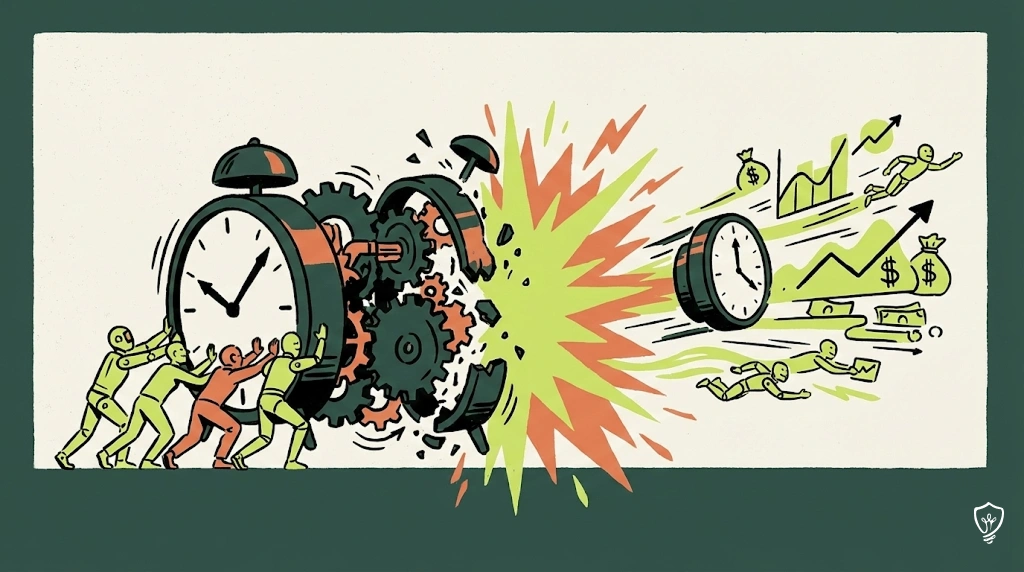
The business world is transitioning from an era where AI merely “generates” content (generative) to a new age where it personally “executes” work and “makes decisions” (agentic). The article penned by Vinciane Beauchene, Nicolas de Bellefonds, Djon Kleine, Rich Lesser, Amanda Luther, Tom Martin, and Daniel Sack, and published by Boston Consulting Group (BCG) on December 15, 2025, heralds this transformation.
The article in question proves that this shift is not merely an increase in operational efficiency; it is a radical “operating model shift” that reduces engineering processes in shipbuilding by 40% and delivery times by 60%, while increasing sales in telecommunications by 5-fold.
However, managing this technological leap is not simply about installing new software. When viewed through the lens of Bruce Henderson’s theory of competition, Henry Mintzberg’s critiques of planning, and John Kotter’s architecture of change, this transformation gains a much deeper meaning for leaders.
In this context, the warning Gary Hamel and C.K. Prahalad issued thirty years ago in their legendary Harvard Business Review article remains valid for the AI era today: The challenge is not merely to “catch up” with competitors, but to rebuild core competencies to “create the future.” Agents are the tools for this rebuilding.
Here is a re-reading of the “Now, Next, and Always” roadmap presented by the BCG authors, through the eyes of management classics:
1. The New Nature of Competition: Henderson and “Proprietary Intelligence”
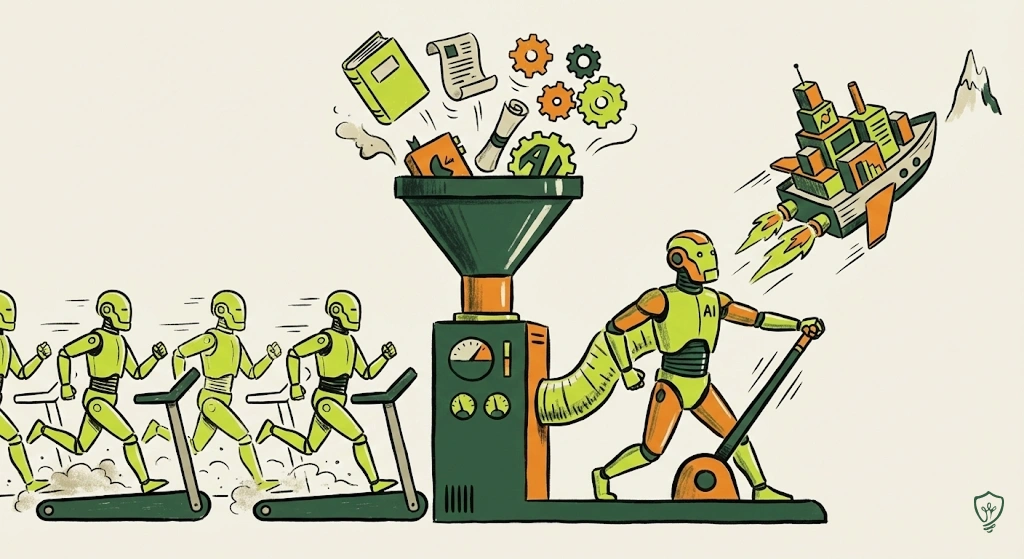
The BCG article emphasizes that the greatest power of agents emerges not when they are trained on generic data, but when they are trained with the company’s own “context” and “proprietary intelligence.”
What Does Classic Theory Say? BCG founder Bruce Henderson defines the purpose of strategy as “compressing time by managing natural competition.” This is not about working faster; it is about systematically eliminating the delays between decision, learning, and execution. According to Henderson, in a rich environment where competitors resemble one another, possessing a “critical mass of knowledge” is essential to create a difference.
Takeaway for the Executive: Using your agents solely for speed (an “evolutionary” approach in Henderson’s terms) only brings you to the same level as your competitors. Integrating the “Business Context Fabric” suggested by the BCG authors—namely goals, resources, and constraints—into agents is the only way to create the “unique advantage” Henderson spoke of. Agents are the levers that transform that “tacit knowledge” your institution has accumulated for years into an instant competitive advantage.
2. Structure and Autonomy: Mintzberg’s “Programming” Vision
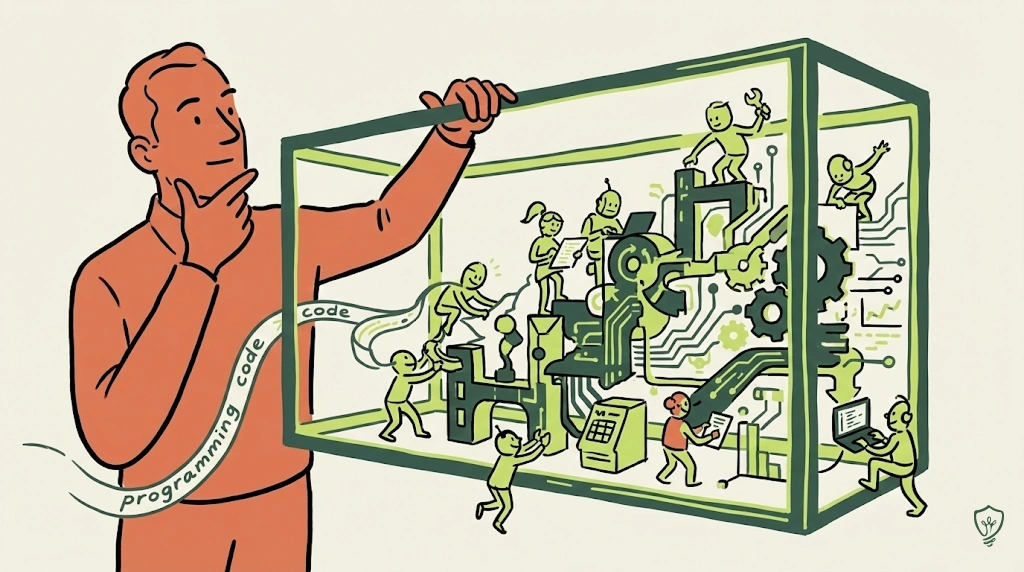
The BCG authors propose redesigning workflows with a “zero-based” approach and granting agents “freedom within a frame.”
What Do Classic and Modern Theories Say? Henry Mintzberg argues that the greatest mistake of strategic planning is severing the act of “thinking” (synthesis) from “doing” (analysis/programming). According to him, “programming” is the codification of an existing vision. This approach aligns with the “Octopus Organization” model described by Jana Werner and Phil Le-Brun in Harvard Business Review (November 2025). Just as an octopus’s arms can think and act independently while working in perfect concert with a central nervous system, modern organizations can only survive in a complex world through such “distributed intelligence.”
Takeaway for the Executive: AI agents are the ideal “strategic programmers” Mintzberg imagined and the “independently thinking arms” described by Werner and Le-Brun. They can “codify” and elaborate on your vision and strategy. However, Mintzberg’s warning remains valid today: “Systems cannot think, they only process data.” The “human-in-the-loop” emphasis in the BCG article becomes critical here. Executives must remain on the side of “synthesis” and “vision,” while agents should be the “programmers” and executors of this vision. Giving agents “freedom within a frame” provides a digital embodiment to Mintzberg’s concept of “emergent strategy.”
3. The Mathematics of Transformation: Kotter and the 10/20/70 Rule
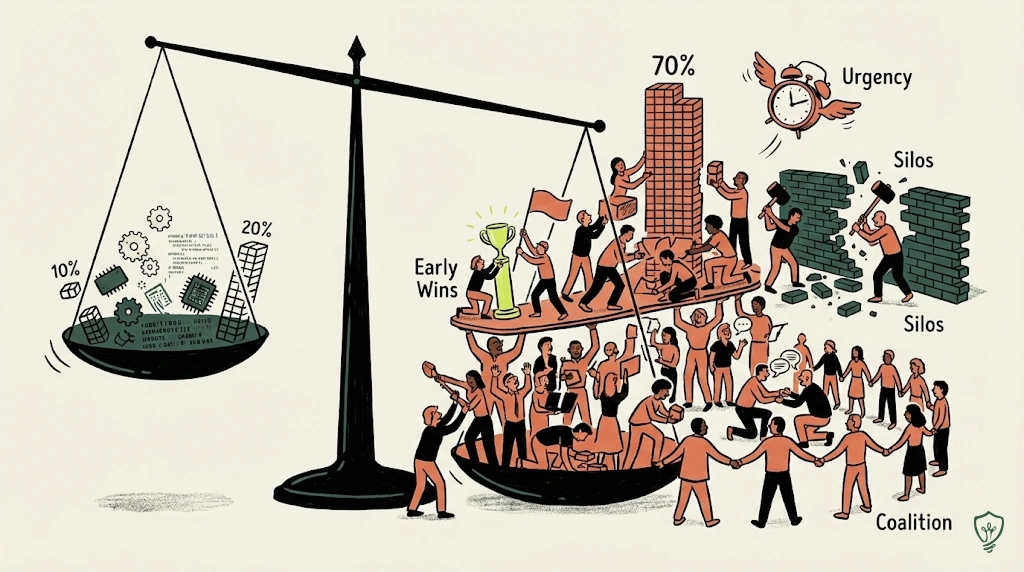
One of the most striking metrics in the BCG article is the 10/20/70 rule: Success is 10% algorithm, 20% technology, and 70% people and processes.
What Does Classic Theory Say? When listing the reasons for the failure of transformation projects, John Kotter cites not technological inadequacy, but rather “not establishing a great enough sense of urgency” and “not anchoring changes in the corporate culture.” According to Kotter, “generating short-term wins” is of vital importance.
Takeaway for the Executive:
The Kotter Error (Lack of Coalition): The BCG authors state that transformation must be “business-led.” Kotter also asserts that without a “powerful guiding coalition,” transformation will remain merely an IT project and face resistance. Since Agent technology breaks down silos, the leadership coalition is more critical than ever.
Early Wins: The article’s advice to “get early wins from big bets” aligns perfectly with Kotter’s principle to “Plan for and create short-term wins.” Before scaling agents across the entire company, declaring “victory” in pilot areas that yield clear results is essential to break corporate resistance.
Conclusion: The CEO’s New Agenda
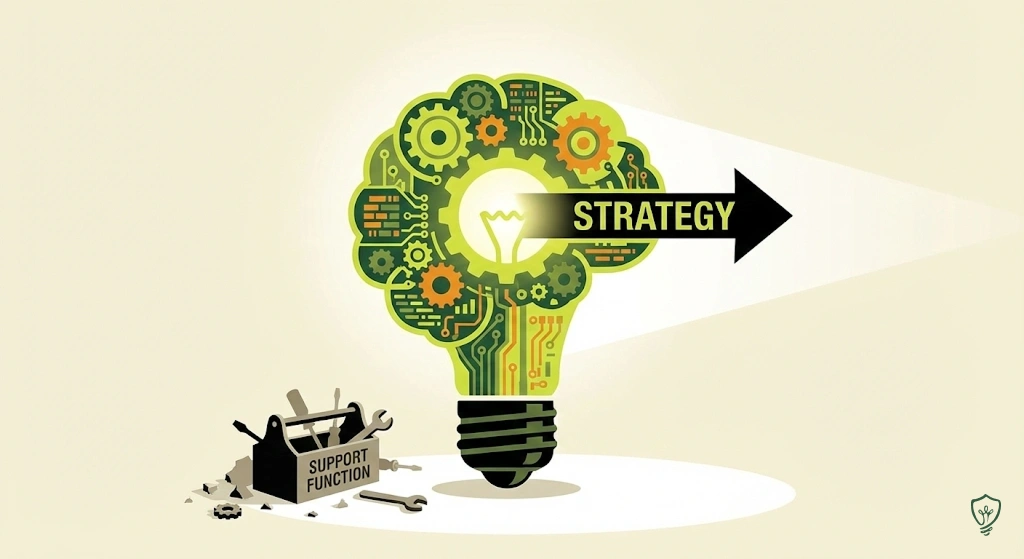
The vision of the BCG authors is clear: Technology is no longer a separate “support function” from strategy; it is strategy itself.
Leaders who succeed in this new era will be those who:
Seek competitive advantage by “compressing time” like Henderson,
Position agents as “programmers of strategy” like Mintzberg,
Never forget that 70% of transformation is human, like Kotter,
And, as Charles Galunic emphasizes in Backstage Leadership, master the “invisible work” of the backstage—shaping the culture and capabilities that fuel the organization—rather than merely seeking the spotlight of the front stage.
However, this new “organism” being built must not only be fast; as André Hoffmann and Peter Vanham emphasize in their book The New Nature of Business, it must serve a purpose that ensures systemic sustainability by growing not just financial capital, but also “social and natural capital.” The machine consumes; the organism thrives alongside the ecosystem it inhabits.
The question is: Will your agents merely perform routine tasks, or will they be an extension of your company’s “strategic brain”?
Levent Yaralı
29.12.2025
REFERENCES
Beauchene, V., de Bellefonds, N., Kleine, D., Lesser, R., Luther, A., Martin, T., & Sack, D. (2025). How Agents Are Accelerating the Next Wave of AI Value Creation. Boston Consulting Group. https://www.bcg.com/publications/2025/agents-accelerate-next-wave-of-ai-value-creation (Accessed on: December 15, 2025)
Henderson, B. (1981). The Concept of Strategy. Boston Consulting Group. https://web-assets.bcg.com/d1/f0/27d41139452d95003e9862d8d9f6/the-concept-of-strategystedit-tcm80-46371-1.pdf (Accessed on: December 29, 2025)
Hamel, G., & Prahalad, C. K.(1994). Competing for the Future. Harvard Business Review, July–August.
https://hbr.org/1994/07/competing-for-the-future (Accessed on: December 29, 2025)
Mintzberg, H. (1994). The Fall and Rise of Strategic Planning. Harvard Business Review, January–February. https://hbr.org/1994/01/the-fall-and-rise-of-strategic-planning (Accessed on: December 29, 2025)
Werner, J., & Le-Brun, P. (2025). Become an Octopus Organization. Harvard Business Review, November–December. https://hbr.org/2025/11/become-an-octopus-organization
(Accessed on: December 29, 2025)
Kotter, J. P. (1995). Leading Change: Why Transformation Efforts Fail. Harvard Business Review, March–April. https://hbr.org/1995/05/leading-change-why-transformation-efforts-fail-2 (Accessed on: December 29, 2025)
Galunic, C. (2020). Backstage Leadership: The Invisible Work of Highly Effective Leaders. Palgrave Macmillan.
(Accessed on: December 29, 2025)