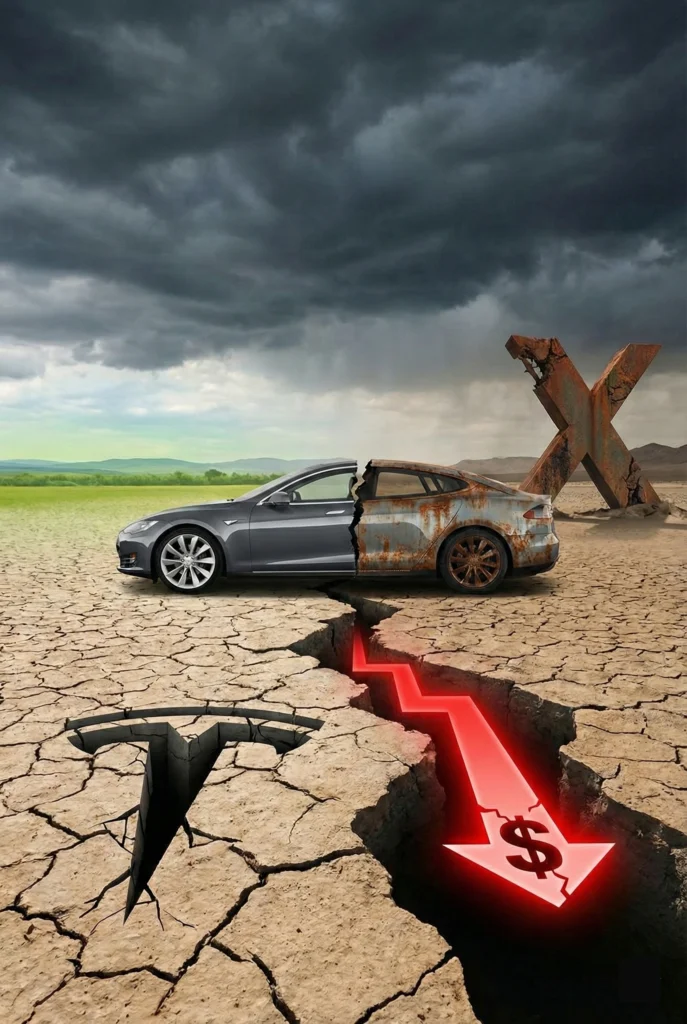
As we navigate through 2025, the automotive world is witnessing a case study destined for the curriculum of modern business schools: Tesla’s dramatic 26.2% erosion in brand value, plummeting to $42.9 billion.
In a period described by the Brand Finance Global 500 report as “The Great Decoupling,” where competitors like BYD, Mercedes, and BMW are seizing market share, Tesla’s hemorrhage is not a failure of engineering, but a failure of leadership. It is a textbook example of “Reputational Erosion.” Tesla is no longer battling just for EV supremacy; it is battling the shadow cast by its own CEO on the platform formerly known as Twitter.
In marketing literature, this is known as “CEO Brand Contagion.” Every aggressive interaction on X pushed a potential Tesla buyer away from the showroom. According to data from market intelligence firm Caliber, cited by Reuters, Tesla’s “Consideration Score”—a metric tracking consumer intent to purchase—collapsed from highs of 70% to lows of 31% as Musk’s polarizing behavior on X intensified. The data is clear: The brand has become collateral damage in its leader’s culture war.
1. The X Factor: Toxic Brand Contagion
Elon Musk’s acquisition and subsequent rebranding of Twitter to X did not merely result in the greatest destruction of social media value in history (a staggering 91% drop since 2022); it created a conduit of toxicity that infected the Tesla brand. As X transformed into Musk’s personal megaphone, his behavior on the platform began to corrode the finish on Tesla’s hood.
In marketing literature, this is known as “CEO Brand Contagion.” Every aggressive interaction on X pushed a potential Tesla buyer away from the showroom. According to data from market intelligence firm Caliber, cited by Reuters, Tesla’s “Consideration Score”—a metric tracking consumer intent to purchase—collapsed from highs of 70% to lows of 31% as Musk’s polarizing behavior on X intensified. The data is clear: The brand has become collateral damage in its leader’s culture war.
2. War on the Customer: The “Woke Mind Virus” Paradox
At the heart of Tesla’s valuation drop lies a tragic irony: Musk used X to aggressively target the exact demographic that constituted Tesla’s most loyal customer base—the urban, educated, eco-conscious liberal.
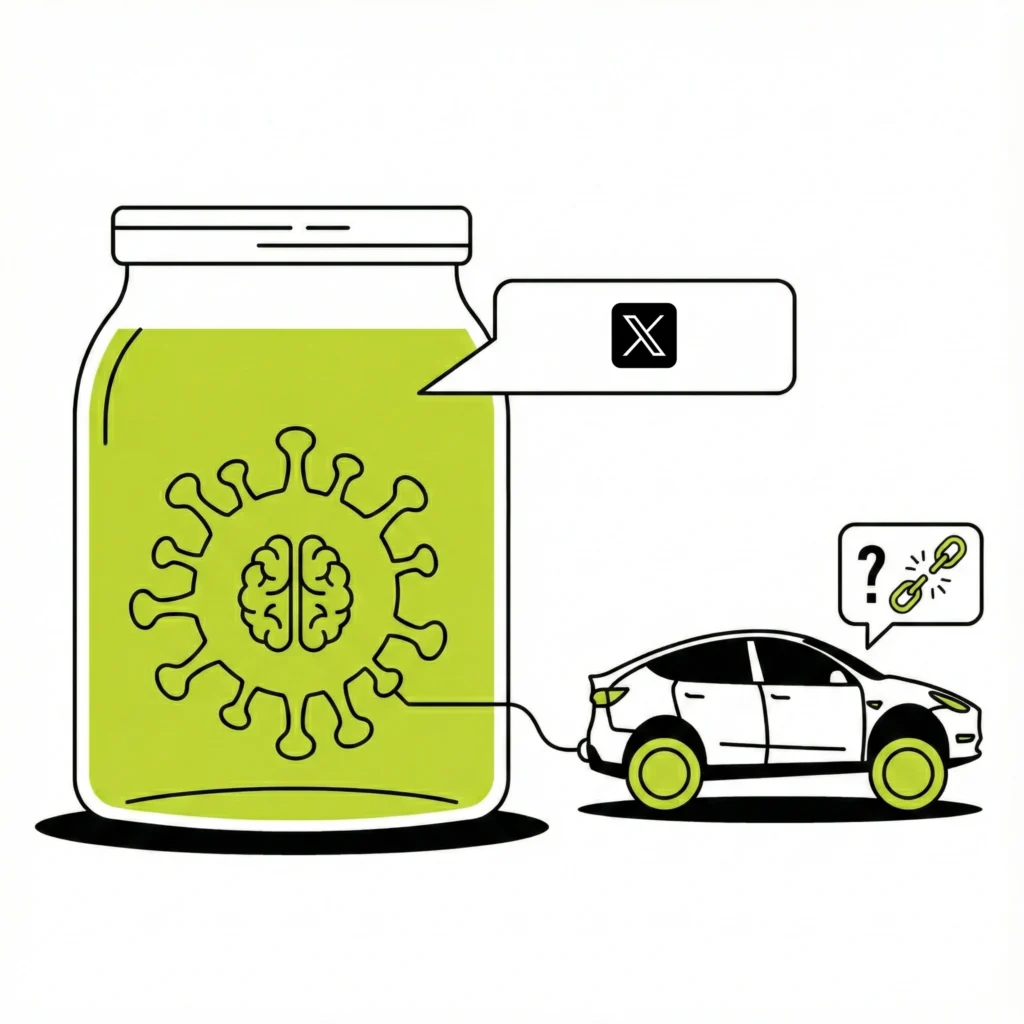
Musk’s frequent crusades against the so-called “Woke mind virus” and his alignment with the far-right of the political spectrum served to alienate his core market. Pew Research data has long established that Democratic voters are significantly more inclined to purchase electric vehicles than Republicans. Yet, Musk’s digital persona played directly against this demographic reality.
A viral comment from an X user encapsulated this sentiment perfectly:
“Driving a Tesla used to signal ‘I care about the future.’ Now, it signals ‘I endorse Elon’s chaos.’ It has become the new MAGA hat, and I don’t want to wear it.”
3. “Go F*** Yourself”: The Breaking Point of Trust
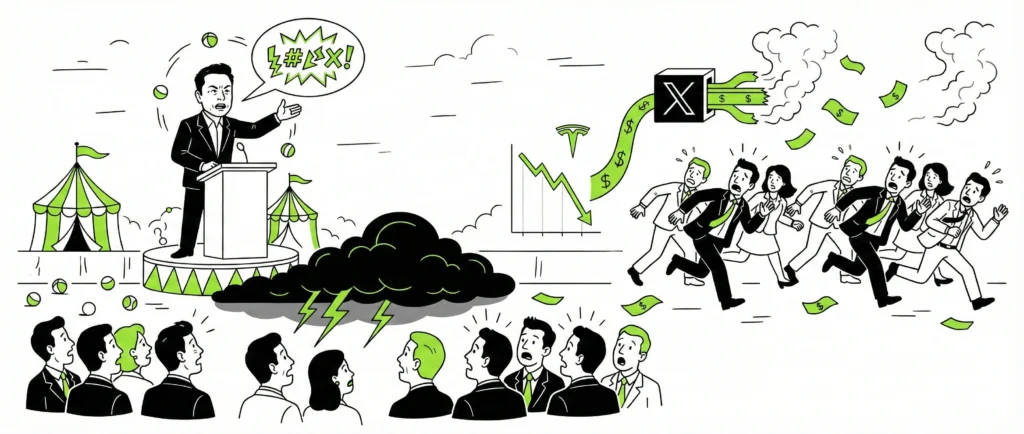
For institutional investors and corporate partners, the watershed moment was Musk’s infamous outburst at the New York Times DealBook Summit. Addressing the advertisers who had fled X due to concerns over hate speech, Musk explicitly told them to “Go f* yourself.”**
This moment did more than just decimate X’s advertising revenue (which fell from $1 billion quarterly to $600 million); it sent a chilling signal to Tesla shareholders: “This CEO is no longer acting rationally.”
Dan Ives, the star analyst at Wedbush and a long-time Tesla bull, described Musk’s X escapades and his increasingly erratic behavior as a “circus” and a “black cloud” hanging over the Tesla brand. Wall Street, witnessing a CEO who spent his days propagating conspiracy theories and “trolling” on X rather than focusing on strategy, began deducting a heavy “Management Risk Premium” from Tesla’s stock.
4. The Opportunity Cost: The Rise of “Drama-Free” Rivals
A critical driver of the 2025 devaluation is that the consumer is no longer devoid of choice. While a prospective buyer reads Elon Musk’s latest polemic on X, they are simultaneously browsing the “Build Your Own” pages for the BYD Seal, BMW i-Series, or Mercedes EQ.
These competitors offer comparable, if not superior, technology without the chaos. According to Bloomberg analysis, particularly in the European market, the migration away from Tesla is driven less by product quality and more by the brand becoming a “political burden.” Consumers are opting for competence without the controversy.
Conclusion: The Thin Line Between Genius and Liability
Tesla’s 26.2% value loss in 2025 is the result of psychological metrics overriding financial ones. While Elon Musk claims he acquired X to protect “freedom of speech,” Tesla shareholders have ultimately paid the bill for that freedom with billions in lost value.
The lesson of the modern economy is stark: If a CEO becomes louder than the product, the noise eventually drowns out the value. Tesla has become the first trillion-dollar contender to pay the “Polarization Tax” at the highest possible bracket.